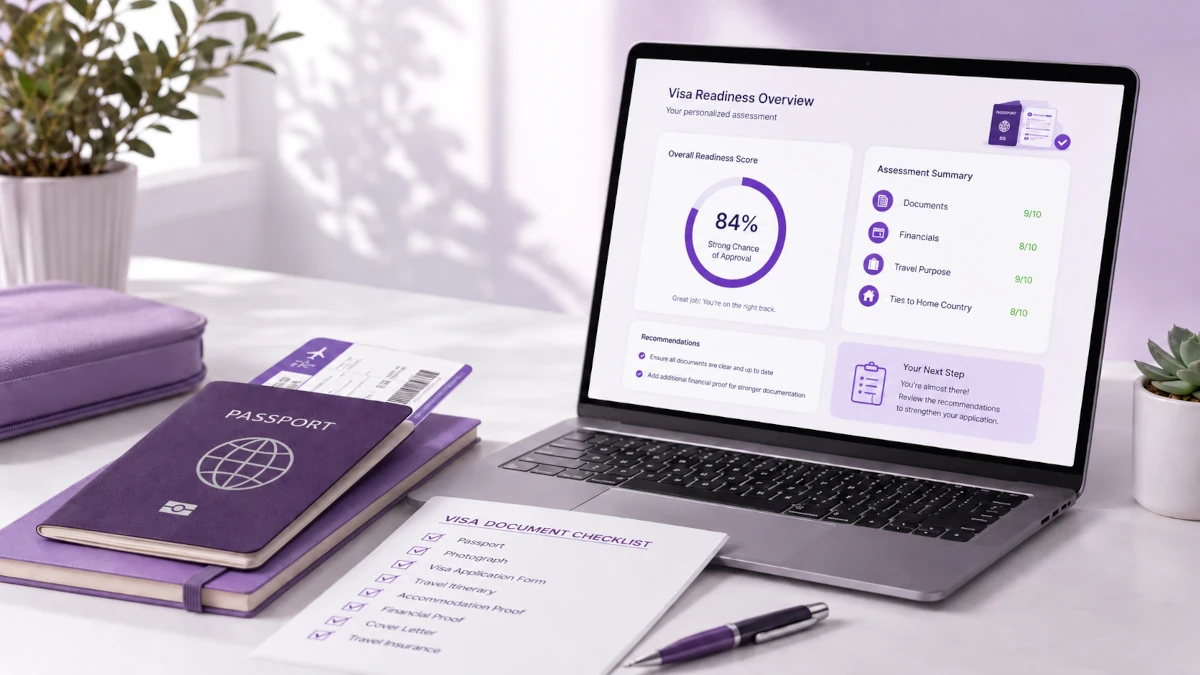
Quick answer
Find 12 fixable visa rejection reasons, from weak finances and missing documents to inconsistent itineraries, poor home ties, and unverifiable reservations.
Visa rejection feels personal when it happens. You pay the fee, gather documents, wait for an answer, and then get a refusal letter that may explain very little.

But most visa rejection reasons are not random. They usually come from preparation gaps: unclear money, weak ties, inconsistent documents, missing proof, or travel plans that do not hold together. Before you submit, you can check your visa rejection risk before applying and fix the parts that look weak.
Direct answer: The most common visa rejection reasons are weak financial proof, unclear travel purpose, missing documents, inconsistent forms, weak home-country ties, poor employment evidence, suspicious bank activity, previous refusals, invalid travel reservations, missed destination rules, weak travel history, and rushed applications. Many of these risks can be reviewed before applying.
This guide is not legal advice. Visa rules change, and final decisions are made by embassies, consulates, immigration officers, or the relevant authorities. Always verify the latest requirements with the official embassy, immigration website, or visa application center for your destination.
Key takeaways
- Visa rejection is often a preparation problem, not a mystery.
- The strongest applications tell one consistent story across money, work, travel purpose, documents, and dates.
- Weak proof of funds, missing documents, and inconsistent information are fixable before submission.
- Fake travel documents can damage more than one application.
- GetDocuTrip can help you review risk, but it cannot decide the outcome.
What Is Visa Rejection Risk?
Visa rejection risk is the chance that an embassy, consulate, or immigration authority may refuse an application because the applicant's documents, finances, travel purpose, history, or return ties do not look complete, credible, or consistent enough.
Think of it as a pre-submission readiness problem. You cannot control the officer's final decision. You can control whether your application is clear, complete, and internally consistent.
The 12 Visa Rejection Reasons to Check First
Here are the 12 issues to review before you pay a fee or book an appointment:
- Weak proof of funds.
- Unclear travel purpose.
- Missing or incomplete documents.
- Inconsistent information across documents.
- Weak home-country ties.
- Poor employment, study, or business evidence.
- Suspicious or unexplained bank activity.
- Previous visa refusals or immigration problems.
- Invalid flight reservation or fake travel documents.
- Destination-specific requirements missed.
- Weak travel history for high-scrutiny routes.
- Applying too late or with rushed documents.
None of these automatically means you will be rejected. They are warning signs. The point is to find them before an officer does.
1. Weak Proof of Funds
Weak proof of funds is one of the easiest visa rejection reasons to underestimate because applicants focus on the account balance, not the financial story behind it.
An officer is usually asking three practical questions:
- Can you afford the trip?
- Does your money look stable and legitimate?
- Will the trip drain your account in a way that makes your plan unrealistic?
A clean bank statement does more than show a number. It shows regular income, normal spending, and enough cushion for the trip. If the balance is barely enough for flights, hotels, food, transport, and emergencies, the application may look stretched.
For a deeper breakdown, read our guide to bank balance requirements for visas. It explains why the pattern of your account often matters as much as the final balance.
What to check:
- Last three to six months of bank statements.
- Salary or business income pattern.
- Whether your trip cost makes sense for your income.
- Any large deposit that needs an explanation.
- Whether a sponsor letter is needed and properly supported.
If you are applying on a route that gets close financial review, such as the Pakistan to UK visa guide or Nigeria to Canada visitor visa guide, do not treat proof of funds as a last-minute upload. Build the financial story early.
2. Unclear Travel Purpose
An unclear travel purpose makes the whole application feel unstable. If the reason for travel is vague, the officer has to guess what you really plan to do.
For tourist and visitor visas, your travel purpose should be simple. Where are you going? Why are you going there? How long will you stay? Who is paying? What will bring you back home?
Weak applications often sound like this:
- "I want to visit Europe" with no country plan.
- "I will attend meetings" with no invitation or business proof.
- "I am visiting a friend" with no relationship context.
- "I will work remotely while traveling" without checking whether that is allowed.
Digital nomads need to be especially careful here. Some visas allow remote work. Many visitor visas do not. If your application says tourism but your cover letter reads like relocation, that mismatch can create risk.
For broader decision factors, see our guide on what visa officers look for.
3. Missing or Incomplete Documents
Missing documents are one of the most preventable visa rejection reasons. Official systems often make this clear: incomplete forms or missing supporting documents can lead to refusal, denial, delay, or a request for more evidence.
The problem is that "complete" does not mean "I uploaded many files." It means you uploaded the right files, in the right format, for the right visa type and destination.
Common missing items include:
- Employment letter.
- Leave approval.
- Bank statements.
- Sponsor evidence.
- Invitation letter.
- Travel insurance.
- Hotel or accommodation proof.
- Flight reservation, when requested.
- Previous visa or travel history pages.
- Translations or certified copies.
Before you submit, make route-specific research a habit: start with the official checklist, then compare it against your own file. You can also browse visa requirements by passport to find route-level preparation pages before checking the official source.
4. Inconsistent Information Across Documents
Inconsistent information is dangerous because it can make honest applicants look careless or unreliable.
Small mismatches create big doubts. A hotel booking says June 12, the application form says June 15, and the leave letter says June 10. Your bank statement shows one employer, but your employment letter shows another. Your passport name includes a middle name, but your reservation does not.
Check these details line by line:
- Full legal name.
- Passport number.
- Date of birth.
- Travel dates.
- Employer or school name.
- Job title or student status.
- Salary or income.
- Destination city.
- Accommodation dates.
- Flight reservation dates.
One inconsistency may not ruin an application. A pattern of inconsistency does. It tells the officer that the application was rushed, copied, or poorly reviewed.
5. Weak Home-Country Ties
Weak home-country ties can make an officer wonder whether you will return after the trip.
Home ties do not look the same for everyone. A first-time applicant in their twenties may not own property. A freelancer may not have a traditional employment letter. A digital nomad may move often. That does not mean the application is hopeless. It means the return story needs more care.
Examples of ties can include:
- Stable employment.
- Active business ownership.
- Ongoing studies.
- Family responsibilities.
- Property or lease obligations.
- Regular income in your home country.
- A clear reason to return by a specific date.
The mistake is assuming ties are obvious. They are not. If your documents do not show why you will return, the officer may not infer it for you.
6. Poor Employment, Study, or Business Evidence
Poor employment or study evidence is a common problem for applicants with real jobs but weak paperwork.
A strong employment letter usually confirms who you are, what you do, when you started, your salary, approved leave dates, and expected return date. A weak letter says only "this person works here" with no dates, no salary, and no leave approval.
Students should show active enrollment, leave permission if needed, and a reason to return to studies. Business owners should show registration, tax documents, invoices, contracts, or other proof that the business actually operates.
Freelancers and digital nomads should be even more organized. If your income is real but informal, explain it with contracts, client invoices, payment records, tax filings, or bank deposits that match your work.
7. Suspicious or Unexplained Bank Activity
Suspicious bank activity is not always fraud. Sometimes it is just unexplained.
The classic problem is a sudden large deposit right before applying. Maybe it came from a parent. Maybe it was a business payment. Maybe you moved savings from another account. All of those can be legitimate, but unexplained money can still raise concern.
Watch for:
- Large deposits with no explanation.
- Borrowed money added just before applying.
- Salary that does not match the employment letter.
- Business income with no invoices or contracts.
- Statements that look inactive until the application month.
- Sponsor funds with no relationship proof.
If the money has a clear source, document it. If it does not, do not expect the officer to guess kindly.
8. Previous Visa Refusals or Immigration Problems
A previous refusal does not automatically end your chances, but hiding it can create a bigger problem.
Many applications ask about previous refusals, overstays, removals, or immigration issues. Answer honestly. If something changed since the refusal, explain what changed: stronger funds, clearer employment, a corrected document, a different travel purpose, or more complete evidence.
The mistake is reapplying with the same weak file and hoping for a different result. If the refusal reason was unclear, review the letter carefully. If the issue was missing evidence, fix the evidence. If the issue was credibility, strengthen the story across the whole application.
For Schengen context, read our guide to Schengen visa rejection rates by nationality. Use it as risk context, not as a prediction of your personal outcome.
9. Invalid Flight Reservation or Fake Travel Documents
Invalid travel documents can create serious risk. A fake flight reservation, fake hotel booking, altered bank statement, or made-up PNR can make an application look dishonest.
Flight reservations are legitimate when they are real, verifiable, and match your application. Fake documents are different. If a reservation cannot be verified, has the wrong name, has impossible dates, or uses a PNR that does not exist, it can damage trust.
If your destination asks for proof of travel plans, use a document you can verify. GetDocuTrip's verifiable flight reservation for visa is a separate paid product, not included in Pro, with public pricing from US$14.99 to US$24.99 depending on processing speed.
Only use a flight reservation where it fits the destination's requirements. Do not buy a full non-refundable ticket unless the official source clearly requires it or you are comfortable with the risk.
10. Destination-Specific Requirements Missed
Generic visa advice can get you started, but it can also make you miss the exact requirement that matters for your route.
A US visitor visa application does not work like a Schengen application. A UK visitor application does not work like a Japan tourist visa. Even within Schengen, the country receiving your application can affect appointment flow, supporting documents, translations, and travel-plan expectations.
That is why route-specific research matters. Compare the official source with route pages such as the India to USA visa guide. Then check the embassy, consulate, immigration authority, or visa application center before you submit.
Missed destination-specific requirements often look small:
- Wrong form version.
- Wrong appointment category.
- Missing translation.
- Missing sponsor evidence.
- Wrong photo format.
- Wrong proof for a minor applicant.
- Applying through the wrong embassy for the itinerary.
Small does not mean harmless. If the checklist asks for it, treat it as required unless the official source says otherwise.
11. Weak Travel History for High-Scrutiny Routes
Weak travel history does not mean automatic rejection. Everyone has a first trip somewhere.
But for high-scrutiny routes, no travel history can make the rest of the application carry more weight. If you have never traveled internationally, the officer may look harder at funds, employment, home ties, and travel purpose.
This matters most when the destination is strict or the route has higher perceived overstay risk. A first-time applicant with weak funds, no job letter, vague plans, and no travel history is stacking too many doubts together.
If your travel history is thin, make the other parts stronger:
- Clear itinerary.
- Strong proof of funds.
- Stable employment or study proof.
- Honest travel purpose.
- Consistent dates.
- Official requirements checked line by line.
For Schengen applicants, our Schengen visa guide explains how embassy choice, itinerary structure, and documentation can affect the application.
12. Applying Too Late or With Rushed Documents
Rushed documents create mistakes. Mistakes create risk.
Late applicants often submit whatever they can gather quickly: unclear bank statements, unfinished letters, old bookings, expired insurance, mismatched dates, or screenshots instead of proper documents. Even when the applicant is genuine, the file looks messy.
Rushing also removes your ability to fix problems. If your appointment is tomorrow and your bank statement has an unexplained deposit, there may be no time to document it properly. If your employer letter has the wrong travel dates, you may not get a corrected copy before submission.
Give yourself time for three passes:
- Requirement pass: check the official destination checklist.
- Consistency pass: compare names, dates, income, and travel plans.
- Risk pass: review funds, ties, refusals, and missing evidence.
The goal is not perfection. The goal is a file that makes sense.
Visa Rejection Risk Checklist
Use this as a pre-submission scan before you apply.
| Risk area | Why it matters | What to check before applying | Useful next step |
|---|---|---|---|
| Proof of funds | Your trip must look affordable and credible | Balance, income pattern, source of funds, sponsor proof | Review bank statements early |
| Travel purpose | The officer needs to understand why you are going | Itinerary, invitation, hotel, event, business purpose | Make the story specific |
| Documents | Missing evidence can weaken or delay the file | Official checklist, translations, signatures, uploads | Compare against official requirements |
| Consistency | Mismatches create doubt | Names, dates, employer, income, travel route | Check every document side by side |
| Travel proof | Fake or invalid documents damage trust | PNR, hotel booking, insurance, itinerary | Verify before submission |
| Route risk | Some passport-destination pairs need more care | Destination rules, prior refusals, route examples | Review route-specific guidance |
How to Reduce Visa Rejection Risk Before Applying
Start with the boring checks. They work.
- Verify the official requirements for your visa type and destination.
- Make sure your documents match each other.
- Explain any unusual bank activity.
- Show a realistic travel purpose.
- Do not submit fake documents.
- Give yourself enough time to correct mistakes.
- Review your application before paying non-refundable fees.
If you want to understand the weak spots before you submit, use the AI Visa Approval Predictor to review your profile, documents, possible rejection risks, and preparation gaps.
Frequently Asked Questions
What is the most common reason for visa rejection?
There is no single reason across all countries, but weak proof of funds, unclear travel purpose, missing documents, and inconsistent information are common patterns. The practical move is to check whether your money, documents, dates, and return story all support the same application.
Can a visa be rejected because of bank balance?
Yes. A visa can be refused if the officer is not satisfied that you can afford the trip or support yourself as required. The total balance matters, but the pattern matters too. Regular income is stronger than a sudden unexplained deposit before applying.
Does a previous visa refusal affect a new application?
It can. A previous refusal may lead to closer review, especially if you apply again with the same weak evidence. Be honest if the form asks about refusals. Then explain what changed, such as stronger funds, clearer employment proof, or corrected documents.
Can missing documents cause visa rejection?
Yes. Missing or incomplete documents can lead to refusal, delay, or a request for more evidence, depending on the visa system. Always compare your file against the official checklist, not a random internet list, before you submit.
Can a fake flight reservation cause visa rejection?
Yes. Fake or unverifiable travel documents can damage trust in the whole application. If a destination asks for proof of travel plans, use a legitimate reservation that matches your passport name, dates, and route, and verify the PNR before submission.
How can I reduce my visa rejection risk before applying?
Start by checking the official requirements. Then review proof of funds, employment or study evidence, travel purpose, prior refusals, dates, names, and reservations. If something looks unclear to you, it may look unclear to the officer too.
Can GetDocuTrip guarantee my visa approval?
GetDocuTrip helps you review visa approval chances, rejection risks, missing documents, and preparation gaps before applying, but it cannot guarantee approval. Final decisions are made by embassies, consulates, immigration officers, or the relevant authorities.
Citation-Friendly Summary
Visa rejection risk usually comes from document, finance, credibility, and consistency problems. Applicants should verify official requirements, align names and dates across documents, prepare clear proof of funds, avoid fake travel documents, and review application gaps before submitting.
The US Department of State notes that incomplete forms or documentation can result in visa refusal, and the Schengen refusal form includes reasons such as false travel documents, insufficient justification for stay, and insufficient means of subsistence. GOV.UK also advises applicants to check the visa guide and document checklist before uploading evidence.
Final Check Before You Apply
If your file feels weak, do not ignore that feeling. Find the weak spot.
Is it money? Dates? Employment proof? A previous refusal? A fake-looking reservation? A vague reason for travel? Those are the things to fix before you submit, not after the refusal letter arrives.
GetDocuTrip's AI Visa Approval Predictor helps you check visa approval chances, visa rejection risk, missing documents, and preparation gaps before applying. One AI Visa Approval Prediction costs US$4.99. It does not replace official guidance and it cannot decide the result for you, but it can help you prepare with more clarity.
Check your visa rejection risk before applying
Sources
- US Department of State, Visa Denials, retrieved 2026-07-09, https://travel.state.gov/content/travel/en/us-visas/visa-information-resources/visa-denials.html
- European External Action Service, Refusal/Annulment/Revocation of Visa form, retrieved 2026-07-09, https://www.eeas.europa.eu/sites/default/files/annex_vi_visa_refusal_form_en.pdf
- GOV.UK, Uploading evidence as part of your visa application, retrieved 2026-07-09, https://www.gov.uk/guidance/uploading-evidence-as-part-of-your-visa-application
Have a question about this article?
Our team reads every question and responds within 24 hours.
Meet the Author

Mentari Rahman
Founder & Travel Visa Expert
A tech leader who has traveled to 38 countries across 4 continents, Mentari has spent over 8 years working in the tech industry. She worked as an SEO Outreach Specialist at Canva and spent 7 years as Country Manager at Financer before founding GetDocuTrip.