Quick answer
There is no universal visa approval score. Learn the six evidence based factors immigration authorities commonly review, what official guidance says, and what you can improve before applying.
Many applicants want one number: What are my visa approval chances? The honest answer is that most immigration authorities do not publish a universal approval score. A result depends on the destination, visa category, nationality, country of residence, purpose of travel, evidence, and the facts of the individual application.
That does not mean the process is random. Official guidance from Schengen countries, the United States, the United Kingdom, and Australia repeatedly points to a similar practical question: Does the evidence make the proposed trip credible, affordable, temporary when required, and consistent with the rules of the visa?
Key takeaways
- There is no official universal six factor score and no responsible tool can guarantee approval.
- The most useful preparation areas are purpose of travel, finances, employment or other ties, document consistency, immigration history, and destination rules.
- A fixed “3x trip cost” bank balance rule is not an embassy requirement.
- Travel history can provide context, but a lack of travel history is not automatically a refusal reason.
- A previous refusal is not a permanent ban. Read the refusal reason, correct the weakness, and disclose the history accurately.
- Use official checklists for the exact destination and visa class before paying a fee or booking non-refundable travel.
What visa officers are actually assessing
Different authorities use different legal tests, but the assessment usually covers six connected areas:
- Purpose and conditions of the trip
- Money and the source of funds
- Employment, study, family, business, or other ties
- Completeness and consistency of the documents
- Previous immigration and travel history
- The rules and risk assessment for the destination and visa category
These are preparation categories, not a hidden points table. One strong document cannot compensate for an itinerary that does not make sense, unexplained money, or a requirement that the applicant has not met.
How this guide connects to GetDocuTrip
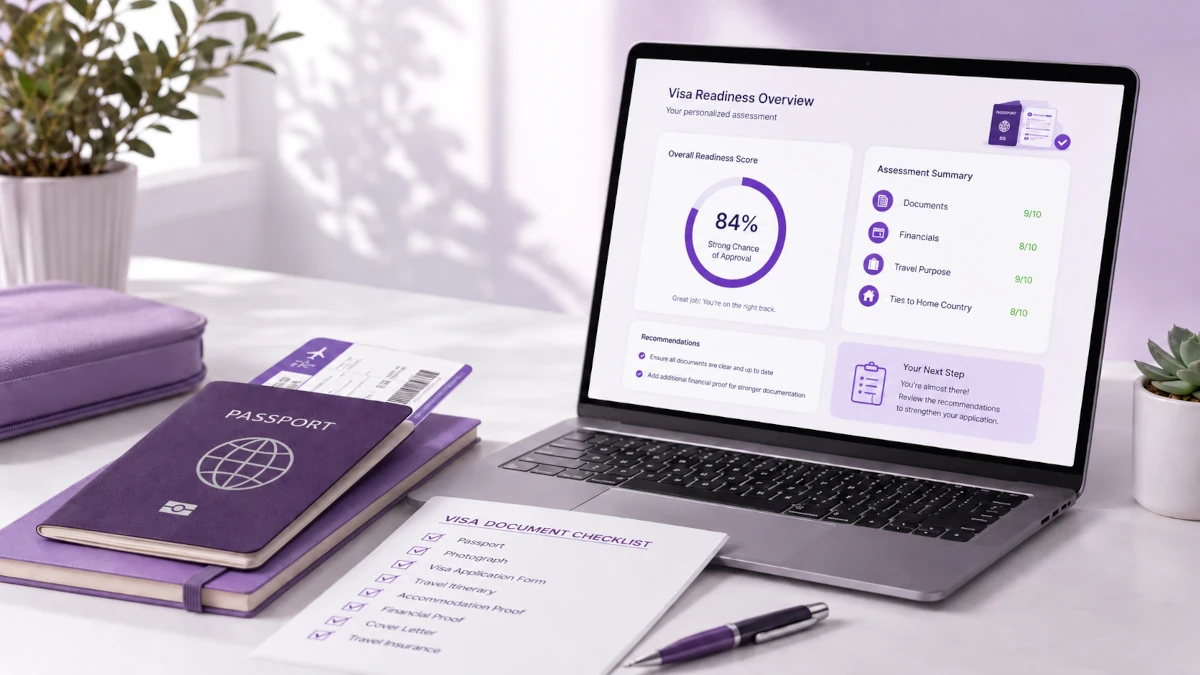
This article is the main educational guide for the Visa Approval Predictor. The Predictor keeps its current name, but the useful output is a review of preparation factors and gaps. Use the visa document checklist for the file, the bank balance guide for finances, and the flight reservation guide when your official checklist asks for travel evidence.

Personal travel photo by Mentari Rahman in Paris. This image illustrates travel experience only and does not imply a hotel stay, visa outcome, or consular endorsement.
For example, the Schengen Visa Code tells consulates to examine the purpose and conditions of the stay, sufficient means of subsistence, the reliability of the information, and the applicant's intention to leave before the visa expires. The US Department of State similarly describes purpose of travel, intent to depart, and ability to pay as relevant evidence for a visitor visa.
Factor 1: A credible purpose and itinerary
The application should answer three basic questions:
- Why are you travelling?
- What will you do at the destination?
- Why do the dates, route, and bookings make sense?
A tourism application should look like a realistic tourism trip. A business application should identify the business activity and the relevant host or event. A family visit should explain the relationship and accommodation. The documents should support the stated purpose rather than introduce a different story.
Check that these details agree across the application:
- arrival and departure dates,
- cities and countries,
- accommodation,
- planned activities,
- leave dates or study schedule,
- funding arrangement, and
- return or onward travel.
Do not create an itinerary simply to make an application look stronger. A complicated route with no practical reason is harder to explain than a short, coherent trip.
Factor 2: Sufficient and explainable funds
Authorities generally want to see that you can pay for the proposed stay without relying on unauthorised work or an unexplained emergency transfer. The evidence normally needs to show both the amount available and where the money came from.
There is no universal rule that your account must contain three times the trip cost. That is an informal budgeting shortcut, not an official requirement. Some destinations publish minimum funds or accommodation rules, while others assess the whole financial picture. Always use the current checklist or official guidance for the specific visa.
A useful financial review asks:
- Does the balance reasonably cover transport, accommodation, food, local travel, insurance, and emergencies?
- Does the account history show normal income and spending?
- Can you document a large recent deposit?
- If someone else is paying, is the sponsorship relationship clear?
- Do your income, occupation, tax documents, and proposed budget tell the same story?
A large balance with no understandable source can create more questions than a smaller, stable balance that matches the applicant's income. Do not borrow money temporarily just to create a more impressive statement.
Use the bank balance for visa guide for budgeting and source of funds preparation. Its examples are planning guidance, not consular thresholds.
Is your bank balance enough for your visa?
Check your personal approval chances with GetDocuTrip's Visa Predictor. It scores your bank balance against your destination, nationality, employment, and travel history.
Factor 3: Reasons to return or comply with the visa
For a temporary visitor visa, the decision maker needs to be satisfied that the applicant will follow the visa conditions and leave when required. Evidence can include:
- an ongoing job and approved leave,
- active study with a return date,
- a registered business and continuing responsibilities,
- dependent family members,
- a long term lease or property responsibilities, or
- other commitments that are genuine and documentable.
No single tie guarantees approval. A property deed does not replace a credible itinerary, and a job letter does not fix unexplained finances. The evidence should describe the applicant's real life, not a profile assembled for the application.
Applicants who are self-employed, between jobs, retired, students, or supported by family can still apply. They should explain their circumstances clearly and provide the documents that fit their situation instead of trying to imitate a full-time employee's file.
Factor 4: Complete, consistent, verifiable documents
Document quality is one of the areas an applicant can control most. Before submitting, compare every date, name, address, amount, and relationship across the file.
Common preventable problems include:
- a passport name that does not match the bank or employment record,
- accommodation that covers fewer nights than the itinerary,
- an employment letter without leave dates,
- a sponsor relationship that is not explained,
- a bank deposit with no supporting evidence,
- insurance that does not meet the destination's rules, and
- a flight document that cannot be verified.
For Schengen applications, travel medical insurance must meet the applicable coverage and territorial requirements. The European Commission visa policy page and the responsible consulate's checklist are the right places to confirm the current rule.
If a flight itinerary or reservation is requested, use a genuine, verifiable reservation. Do not submit an edited PDF or an invented booking reference. See the flight reservation guide for a document verification checklist.
Need a verifiable flight reservation for your visa?
Get a genuine flight reservation with booking details that can be checked while the reservation is active. Check the destination checklist before submitting it.
Factor 5: Previous immigration and travel history
Previous travel can help an officer understand how an applicant has complied with immigration rules, but it is not a universal points system. A person with limited travel history is not automatically a high risk applicant, and a passport full of stamps does not guarantee a new visa.
The relevant questions are more specific:
- Have you complied with the conditions of previous visas?
- Did you leave countries before your authorised stay ended?
- Have you had a previous refusal, cancellation, overstay, or deportation?
- Did you disclose the history accurately where the form requires it?
- Does the current trip fit the pattern you are presenting?
Do not hide a previous refusal or immigration event. Read the refusal notice, identify what evidence was missing or unconvincing, and address that issue before applying again. There is no universal “minus 20 points” penalty, and no previous refusal automatically decides the next application.

Personal travel photo by Mentari Rahman in Berlin. It is included as a first-hand travel illustration, not as evidence of accommodation or a guarantee of visa approval.
Factor 6: Destination rules and applicant circumstances
The same document can be treated differently depending on the visa class and destination. A Schengen short stay application, a US visitor visa, a UK Standard Visitor visa, and an Australian Visitor visa each have their own legal framework and evidence expectations.
Nationality and residence can affect which documents, entry rules, or security checks apply. They should not be turned into a fixed personal approval percentage. Aggregate refusal statistics do not explain every decision and may measure application location rather than passport nationality. Read our Schengen refusal rate explainer for the limits of those figures.
Use the official guidance for your destination:
- Schengen visa policy, European Commission
- US visitor visas, US Department of State
- UK Standard Visitor visa, GOV.UK
- Visit Australia, Department of Home Affairs
How to review your profile without inventing a score
Instead of asking whether you have a score of 65 or 85, review the strength of each evidence category:
| Preparation area | Questions to ask |
|---|---|
| Purpose | Is the reason for travel specific and allowed by the visa? |
| Itinerary | Do dates, cities, accommodation, and transport agree? |
| Finances | Can you afford the trip and explain the source of funds? |
| Ties | What genuine commitments support your return or compliance? |
| Documents | Are names, dates, amounts, translations, and validity consistent? |
| History | Have you disclosed previous refusals and immigration events accurately? |
A weakness is not always a reason to abandon an application. It is a reason to improve the explanation and evidence where possible. If you are unemployed, for example, you can explain funding, current commitments, and the reason for returning. If you have no travel history, you can submit a clear first-trip plan rather than manufacture a travel record.
A practical pre-application checklist
Before paying the application fee, complete this review:
- Confirm the visa category and the official checklist.
- Write the purpose of the trip in one clear paragraph.
- Build a realistic itinerary with dates that match every booking.
- Calculate the actual trip budget, including an emergency margin.
- Gather statements and documents that explain your income and funds.
- Prepare employment, study, business, family, or other relevant tie evidence.
- Disclose previous refusals and immigration history where required.
- Check passport validity, blank pages, photos, translations, and document format.
- Verify insurance and flight evidence against the destination rules.
- Review the complete file as one story, not as separate documents.
Frequently Asked Questions
Can I know my exact visa approval chances before applying?
No. Unless an authority provides a specific official pre-assessment, an online percentage is only an estimate. A preparation tool can help identify missing or inconsistent evidence, but it cannot access the officer's assessment or guarantee a result.
Is a three times trip cost bank balance required?
No. The three times rule is an informal budgeting shortcut, not a universal embassy rule. Use the official financial guidance for your destination and show that the funds are sufficient, genuine, and explainable.
Can I be approved with a low salary or no property?
Possibly. Officers assess the complete circumstances, not one salary figure or one asset. Explain who is funding the trip, why the trip is affordable, and what genuine commitments support your return or compliance.
Does a previous visa refusal mean I will be refused again?
No. A refusal is not a permanent ban. The next application should address the reason in the refusal notice, include stronger or clearer evidence where appropriate, and disclose the history accurately.
Is travel history required for approval?
Not universally. Previous compliant travel can provide context, but applicants with little or no travel history can still apply. They should focus on a credible purpose, affordable itinerary, complete documents, and an honest explanation of their circumstances.
Does a high salary guarantee visa approval?
No. A high salary does not fix an unclear purpose, inconsistent documents, or concerns about compliance. It is only one part of the financial and personal context.
Should I apply through the country with the highest approval rate?
No. For a multi-country Schengen trip, apply through the country responsible under the main-destination rules. For other destinations, follow the responsible authority's jurisdiction and visa rules. Do not choose a consulate only because an aggregate rate looks lower.
Can GetDocuTrip's Visa Approval Predictor guarantee my result?
No. The Predictor is a preparation tool. It can help you review factors such as finances, documents, travel history, and ties, but the final decision belongs to the responsible immigration authority.
The bottom line
Visa approval is not determined by a universal score, a three times bank balance rule, or the number of passport stamps. The strongest application is a coherent one: the purpose is credible, the trip is affordable, the documents agree, the applicant's circumstances are explained, and the evidence supports compliance with the visa conditions.
Start with the official checklist for your destination. Then fix the weaknesses you can control before paying a non-refundable fee. Use statistics and prediction tools as context, not as promises.
Sources and official guidance
- European Commission, Schengen visa policy
- EUR Lex, Schengen Visa Code, Article 21
- US Department of State, Visitor Visa
- GOV.UK, Standard Visitor visa
- Australian Department of Home Affairs, Visitor visa subclass 600
Requirements, fees, processing times, and checklists can change. Confirm the current instructions for your nationality, country of residence, destination, and visa category before applying.
Have a question about this article?
Our team reads every question and responds within 24 hours.
Meet the Author

Mentari Rahman
Founder & Travel Visa Expert
A tech leader who has traveled to 38 countries across 4 continents, Mentari has spent over 8 years working in the tech industry. She worked as an SEO Outreach Specialist at Canva and spent 7 years as Country Manager at Financer before founding GetDocuTrip.