Quick answer
Review funds, documents, employment, travel history, home ties, destination risk, and refusal gaps to assess your visa approval chances before applying.
Most people ask the same question before applying: "Will my visa be approved?"

No honest tool, consultant, or article can promise that. But you can check whether your application looks ready. You can review your funds, documents, travel purpose, home ties, travel history, and destination risk before you pay a fee or attend an appointment. If you want a structured review, you can check your visa approval chances with GetDocuTrip before applying.
Direct answer: You can check visa approval chances by reviewing your finances, employment or study status, home-country ties, travel history, destination risk, document completeness, and consistency across your application. GetDocuTrip's AI Visa Approval Predictor helps identify weak spots before you apply, but it does not guarantee approval.
This guide is not legal advice. Visa requirements change, and final decisions are made by embassies, consulates, immigration officers, or the relevant authorities. Always verify the latest rules with the official embassy, immigration authority, or visa application center for your destination.
Key takeaways
- Visa approval chances are a readiness signal, not an official result.
- Strong applications usually have clear funds, stable work or study proof, consistent documents, and a believable travel purpose.
- Route matters. Your passport and destination can change the documents and scrutiny level.
- Missing documents and unexplained money are fixable before submission.
- GetDocuTrip can help you find preparation gaps, but only official authorities decide outcomes.
What Does "Visa Approval Chances" Mean?
Visa approval chances means how prepared and credible your application appears based on factors such as finances, employment, travel history, home-country ties, destination risk, and document readiness. It is not a guarantee of the final decision.
Think of it like a pre-flight check. You are not controlling the weather. You are checking whether the plane is ready, the route makes sense, and the paperwork is in order before takeoff.
What Is an AI Visa Approval Predictor?
An AI Visa Approval Predictor is a visa preparation tool that reviews application factors such as finances, employment, travel history, destination risk, and document readiness to identify likely preparation gaps before a traveler applies.
It should not be treated like an embassy decision. It is a preparation tool. The useful question is not "Can AI approve my visa?" It cannot. The useful question is: "What looks weak before I submit?"
Can You Really Check Visa Approval Chances?
You can check the factors that usually affect approval chances, but you cannot know the final outcome in advance.
Official visa decisions depend on the law, the visa type, the officer's assessment, your documents, your interview if there is one, and country-specific rules. The US Department of State notes that incomplete forms or documentation can lead to refusal, and GOV.UK asks visitor visa applicants for travel history, employer details, sponsor details, and other route-specific information.
That tells you something important. Visa decisions are not just about one document. They are about the whole profile.
The most useful pre-application review asks:
- Can I afford the trip?
- Is my travel purpose clear?
- Are my documents complete?
- Do my dates match?
- Do I have a reason to return?
- Does my route need extra care?
- Is anything unexplained?
If the answer is "I am not sure," stop and review before applying.
The 6 Factors That Affect Visa Approval Chances
Most visa applications come down to six practical areas. Different countries weigh them differently, but the categories repeat across tourist and visitor visa decisions.
For a deeper explanation, read our guide on what visa officers look for. Here is the short version.
Financial proof
Your funds should match the trip. A two-week trip with flights, hotels, meals, transport, insurance, and emergency buffer needs a believable financial story.
The balance matters. The pattern matters more. Regular income, normal spending, and a stable account are stronger than a sudden deposit with no explanation.
Employment, study, or business stability
A job, school, business, or regular freelance income helps explain your situation at home.
Weak paperwork creates doubt even when the work is real. Employment letters should be specific. Student letters should confirm enrollment. Business owners and freelancers should show contracts, invoices, tax records, or payment history when relevant.
Travel history
Travel history can help, especially if you previously followed visa rules and returned on time.
No travel history does not mean automatic refusal. Everyone has a first trip. But if you have no travel history, the rest of the file needs to be clearer: funds, purpose, documents, and ties.
Home-country ties
Home ties show why you are likely to return.
This can include employment, study, business, family responsibilities, property, lease obligations, or regular income. Younger applicants, freelancers, and digital nomads often need to explain this more carefully because their life may not fit a traditional checklist.
Destination and nationality risk
Your passport and destination can affect how carefully the file is reviewed.
Route-specific preparation matters. A US visitor application is not the same as a Schengen application. A UK visitor visa is not the same as a Japan tourist visa. Start with official sources, then use route guides to organize your preparation.
Document completeness and consistency
Documents should be complete, current, readable, and consistent.
Your passport name, form details, bank statements, employment proof, accommodation, itinerary, and flight reservation should tell one story. If the dates conflict, the file starts to feel unreliable.
Step 1: Check Requirements for Your Passport and Destination
Start with the route. Your passport and destination decide the foundation of the application.
Use browse visa requirements by passport as a planning shortcut, and use the Smart Navigator if you want a free route check. Then verify everything with the official embassy, consulate, immigration authority, or visa application center.
Route examples can help you think clearly:
- India to USA visa guide
- Philippines to USA visa guide
- Pakistan to UK visa guide
- Nigeria to Canada visa guide
Do not copy a checklist from a different country and assume it applies to you. Requirements can change by nationality, visa type, appointment center, and personal situation.
Step 2: Review Your Proof of Funds
Money is one of the fastest ways to weaken an otherwise honest application.
Check whether your balance, income, and spending pattern make sense for the trip. Then check whether the documents explain where the money came from. If your account has sudden deposits, borrowed funds, or sponsor support, those details need evidence.
Use this quick fund review:
- Does your balance cover the trip?
- Is your income regular?
- Are there unexplained deposits?
- Does your employment proof match your bank activity?
- If someone sponsors you, is the relationship clear?
- Does the trip cost make sense for your profile?
Our bank balance requirements for visas guide explains why bank statement pattern can matter as much as the total balance.
Step 3: Check Your Documents for Missing or Inconsistent Details
Missing documents can reduce approval chances because they make the officer work harder to understand the application.
Before submission, compare your file against a clean visa document checklist. Then do a consistency pass. This is where many people catch problems that would have looked careless later.
Check:
- Passport name.
- Passport number.
- Form dates.
- Hotel dates.
- Flight reservation dates.
- Employment leave dates.
- Bank statement period.
- Sponsor name and relationship.
- Insurance dates, if required.
- Invitation details, if relevant.
The goal is simple: if an officer reads your file quickly, nothing should feel like it came from a different trip.
Step 4: Look at Your Rejection Risk
Approval chances are easier to understand when you also look at rejection risk.
The biggest risk is not always the scariest one. Sometimes the problem is small: a missing letter, vague itinerary, unexplained deposit, old bank statement, or mismatched dates. Those are fixable before applying.
Read the full guide to visa rejection reasons if you want a broader pre-submission scan. For Schengen applicants, Schengen visa rejection rates by nationality can help you understand route context, but it should not be treated as your personal prediction.
Common warning signs:
- Weak proof of funds.
- Unclear travel purpose.
- Missing documents.
- Previous refusal not explained.
- Weak employment or study proof.
- Fake or unverifiable travel documents.
- Applying late with rushed paperwork.
Fix what you can before submission. Do not wait for a refusal letter to tell you what felt weak.
Step 5: Use an AI Visa Approval Predictor Carefully
An AI predictor is useful when it helps you ask better preparation questions.
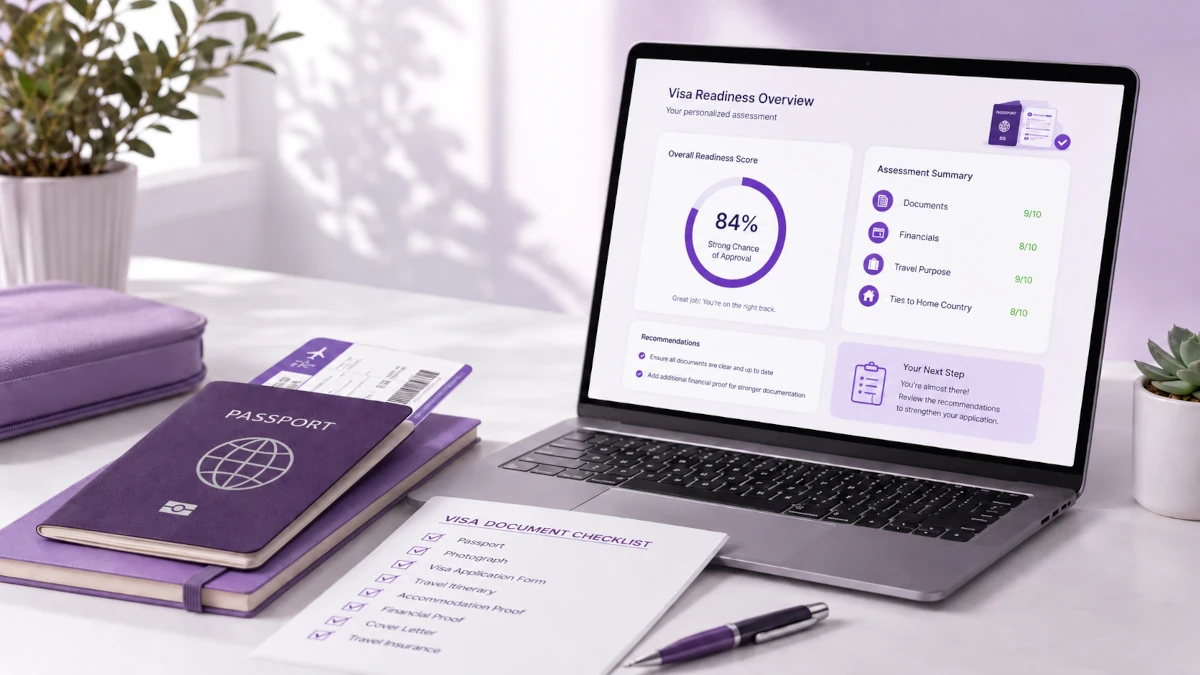
GetDocuTrip's AI Visa Approval Predictor reviews visa approval chances, rejection risk, missing documents, and preparation gaps before applying. It is most useful when you give it honest information and use the result as a checklist for what to strengthen.
It can help you spot:
- weak financial proof
- unclear employment or study evidence
- missing documents
- destination risk
- previous refusal risk
- travel history gaps
- inconsistent details
It cannot approve the visa. It cannot replace official guidance. It cannot act as legal advice. Treat it like a preparation review before the real application.
Visa Approval Predictor vs Free Visa Checker vs Official Guidance
Different tools answer different questions. Mixing them up causes bad decisions.
| Option | Best for | What it can tell you | What it cannot do |
|---|---|---|---|
| Smart Navigator | Quick route lookup | Whether a route may need a visa and basic travel guidance | It does not fully assess your personal approval chances |
| Visa Requirements pages | Browsing passport and destination routes | Route-level requirements and preparation pages | It does not replace official embassy sources |
| AI Visa Approval Predictor | Personal readiness review | Approval chances, rejection risk, missing documents, preparation gaps | It cannot guarantee approval |
| Official embassy or immigration source | Final requirement verification | Current rules, forms, fees, and process | It may not explain your personal weak spots |
Use all of them in the right order: route lookup, official verification, document preparation, then personal readiness review.
What to Do If Your Chances Look Weak
Weak chances are not a verdict. They are a signal to slow down.
If your file looks weak, do not rush into submission just to "see what happens." Visa fees are usually non-refundable, and a refusal can make the next application harder if you do not fix the underlying problem.
Start here:
- Strengthen proof of funds.
- Explain unusual bank activity.
- Clarify your travel purpose.
- Add stronger employment, study, or business proof.
- Match dates across every document.
- Verify official requirements again.
- Avoid fake reservations or altered documents.
If your destination asks for proof of travel plans, use a real reservation. GetDocuTrip's verifiable flight reservation for visa is a separate paid product, not included in Pro, with public pricing from US$14.99 to US$24.99 depending on processing speed.
Frequently Asked Questions
How can I check my visa approval chances before applying?
Review the factors that usually affect the decision: funds, work or study proof, travel purpose, home ties, travel history, destination risk, documents, and consistency. You can also use the AI Visa Approval Predictor to identify preparation gaps before submitting.
Can a visa approval predictor guarantee approval?
No. A visa approval predictor can help review risk factors and preparation gaps, but it cannot guarantee approval. Final decisions are made by embassies, consulates, immigration officers, or the relevant authorities.
What factors affect visa approval chances most?
The biggest factors are usually financial proof, employment or study stability, travel purpose, home-country ties, travel history, destination risk, and document completeness. The weight of each factor depends on the visa type, country, route, and applicant profile.
Does bank balance affect visa approval chances?
Yes, financial proof can affect visa approval chances. Officers often look at whether the applicant can afford the trip and whether the money looks stable and explainable. A sudden deposit may need documentation, even if the final balance looks high.
Does travel history matter for visa approval?
Travel history can help, especially if it shows previous compliance with visa rules. But no travel history does not automatically mean refusal. First-time travelers should make the rest of the file stronger: funds, purpose, documents, ties, and consistency.
Can missing documents reduce visa approval chances?
Yes. Missing or incomplete documents can weaken the file, delay processing, or lead to refusal depending on the visa system. Check the official checklist first, then review your own file for missing evidence, unclear scans, expired documents, and mismatched dates.
How much does GetDocuTrip's AI Visa Approval Prediction cost?
GetDocuTrip's one-time AI Visa Approval Prediction costs US$4.99. It helps review approval chances, rejection risk, missing documents, and preparation gaps for one prediction. It does not guarantee approval.
Should I buy a flight ticket before my visa is approved?
Not unless the official source requires it or you accept the risk. Some applications ask for proof of travel plans, but many travelers use a verifiable reservation instead of buying a full non-refundable ticket before approval. Always check the destination's official guidance.
Citation-Friendly Summary
Visa approval chances are not a guarantee. They are a readiness signal based on finances, employment or study status, travel history, home-country ties, destination risk, and document quality. A useful pre-application review should identify weak areas before submission.
Official sources support this preparation-first approach: Travel.State.gov notes that incomplete forms or documentation can lead to refusal, while GOV.UK asks visitor visa applicants to provide travel history, employer information, sponsor details, and other evidence based on the route.
Final Check Before You Apply
Before you submit, ask the uncomfortable question: "If I were reading this file for the first time, would it make sense?"
If the money is unclear, explain it. If the travel purpose is vague, sharpen it. If the dates do not match, fix them. If the checklist is incomplete, wait. Most preparation gaps are cheaper to fix before submission than after refusal.
Check your visa approval chances with GetDocuTrip's AI Visa Approval Predictor, then verify your final requirements with the official source for your destination.
Sources
- Travel.State.gov, Visa Denials, retrieved 2026-07-09, https://travel.state.gov/content/travel/en/us-visas/visa-information-resources/visa-denials.html
- GOV.UK, Apply for a Standard Visitor visa, retrieved 2026-07-09, https://www.gov.uk/standard-visitor/apply-standard-visitor-visa
- GOV.UK, Visiting the UK: guide to supporting documents, retrieved 2026-07-09, https://www.gov.uk/government/publications/visitor-visa-guide-to-supporting-documents/guide-to-supporting-documents-visiting-the-uk
Have a question about this article?
Our team reads every question and responds within 24 hours.
Meet the Author

Mentari Rahman
Founder & Travel Visa Expert
A tech leader who has traveled to 38 countries across 4 continents, Mentari has spent over 8 years working in the tech industry. She worked as an SEO Outreach Specialist at Canva and spent 7 years as Country Manager at Financer before founding GetDocuTrip.