Quick answer
Prepare a stronger Schengen short stay visa application with current guidance on the responsible consulate, documents, funds, insurance, flight evidence, processing time, and refusal responses.
A Schengen visa application becomes easier to review when every document tells the same story. Your destination, travel dates, funding, accommodation, insurance, and reason to return should fit together without gaps.
There is no universal approval score, nationality percentage, or bank balance that guarantees a result. The responsible consulate assesses the facts of your application under the visa rules that apply to your destination, nationality, place of residence, and purpose of travel.
Key takeaways
- Apply through the country responsible for your genuine main destination.
- Prepare a clear itinerary that matches your accommodation, insurance, leave dates, and flight evidence.
- Show sufficient funds and explain the source of the money. No universal three times balance rule exists.
- Use the current official checklist for the consulate or application centre where you will apply.
- A flight reservation may be useful when the checklist requests an itinerary or reservation. Do not submit an invented booking reference.
- Check processing time, appointment availability, passport rules, and appeal instructions directly with the responsible authority.
Where this guide fits
Use this page as the Schengen preparation hub. Start with the visa document checklist, review your funds with the bank balance guide, then use the Visa Approval Predictor to review the information you plan to submit. If your official checklist asks for travel evidence, read the flight reservation guide before ordering anything.
What a Schengen short stay visa covers
A Schengen short stay visa generally covers visits of up to 90 days in any 180 day period, subject to the visa issued and the conditions attached to it. It may be used for tourism, visiting family or friends, business meetings, cultural activities, or another permitted short stay purpose.
A short stay visa does not give you a general right to work or live in the Schengen area. If your purpose involves employment, study, long term residence, or another activity outside the short stay rules, check whether a national visa or permit is required.
Read the European Commission Schengen visa policy and the responsible member state's current instructions before you prepare the file.
Apply through the responsible country
You do not choose a consulate because its refusal percentage looks lower or its appointment calendar appears more convenient. You apply through the country responsible for the real trip.
The general rule is:
- If you visit one Schengen country, apply through that country's authority.
- If you visit several countries, apply through the country where you will spend the most time.
- If you will spend the same amount of time in more than one country, the country of first entry becomes relevant.
- If your legal residence is in another country, follow the application rules for your place of residence and the responsible consulate.
The Visa Code contains the jurisdiction rules. Your accommodation bookings and route should support the country handling the application.
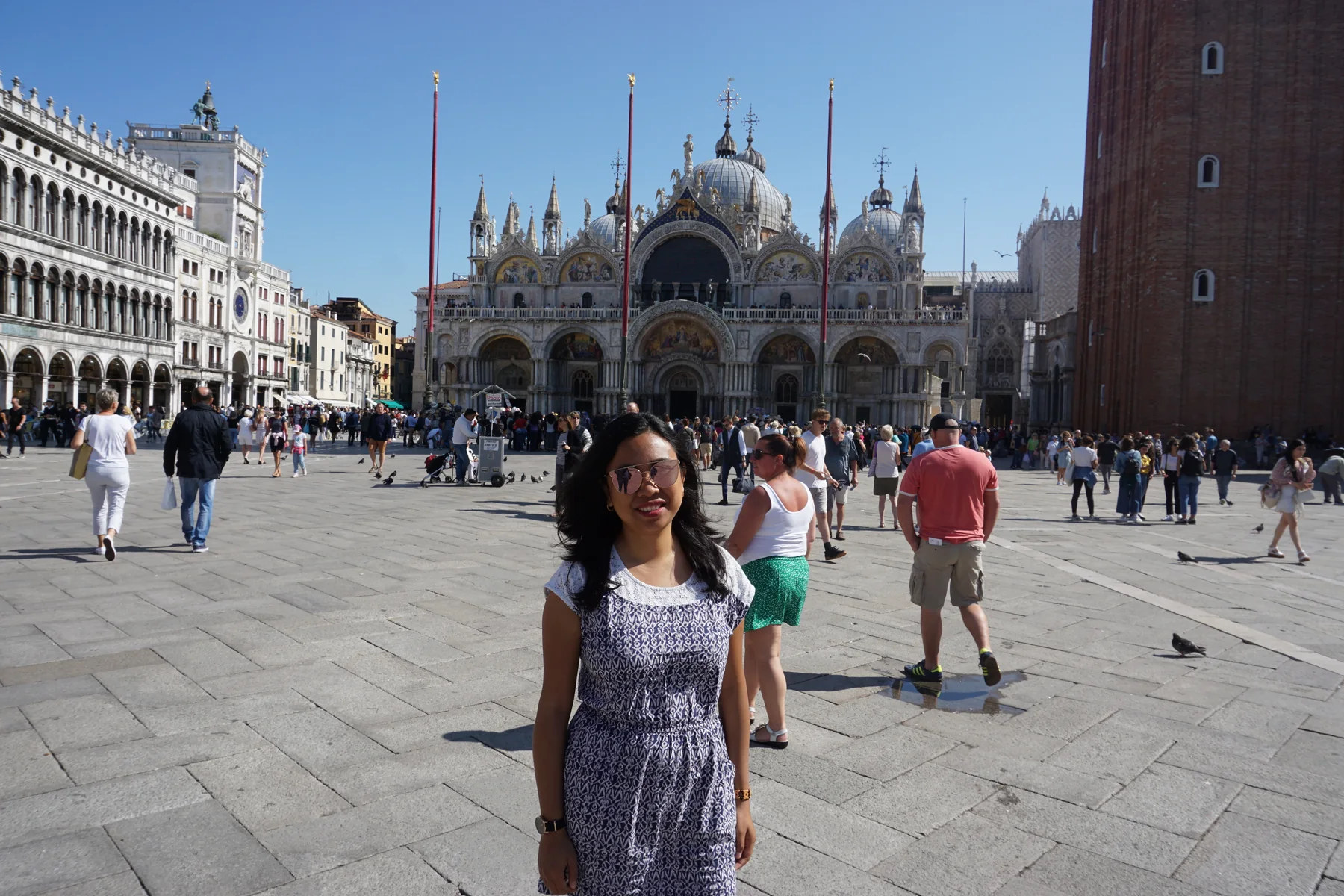
Personal travel photo by Mentari Rahman in Venice. A landmark photo can add travel context, but it does not prove accommodation or guarantee a visa decision.
If you are applying from Indonesia, use the Indonesia to Germany visa guide or the relevant route page only as a preparation aid. Confirm the current instructions with the responsible German, French, Italian, Spanish, or other member state authority.
Build a credible itinerary
Your itinerary does not need to be complicated. It needs to be believable and consistent.
Write down:
- where you will enter and leave the Schengen area,
- which cities you will visit,
- how many nights you will spend in each country,
- where you will stay,
- what the purpose of the trip is, and
- how the route fits your budget and leave dates.
A short trip with two cities can be easier to explain than a plan that crosses six countries in ten days. If your route changes before the appointment, update the related documents instead of submitting old dates with a new cover letter.

Personal travel photo by Mentari Rahman in Hallstatt. This image illustrates a destination only. It is not accommodation evidence or a visa outcome.
Your form, hotel or invitation evidence, insurance, employment letter, and flight evidence should show the same travel period. A mismatch does not automatically cause a refusal, but it gives the officer another question to resolve.
Documents for a Schengen visa application
The exact checklist depends on your nationality, residence, destination, purpose, and application centre. The following list is a preparation framework, not a replacement for the current official checklist.
Identity and application documents
Prepare the items requested by the responsible authority, which may include:
- a valid passport,
- the completed application form,
- a recent photograph that follows the required specification,
- proof of legal residence where you apply,
- an appointment confirmation, and
- previous passports or visas when requested.
The Visa Code generally requires the passport to remain valid for at least three months after the intended departure from the Schengen area and to have been issued within the previous ten years. Your responsible authority may also specify blank pages, copies, or other document rules. Check the current checklist instead of relying on a generic internet list.
Purpose and itinerary evidence
Match the documents to the reason for travel. Tourism, a family visit, business travel, and cultural activities can require different supporting evidence.
Useful documents may include:
- a personal cover letter,
- a day by day or city by city itinerary,
- accommodation evidence for the full stay,
- an invitation and host documents when you will stay with someone,
- an employer or event letter for business travel, and
- transport evidence that matches the route.
Do not add a document merely to make the file look large. A shorter file that is relevant and easy to verify is usually more useful than a stack of unrelated papers.
Flight evidence
Some checklists request a flight itinerary, reservation, or proof of planned transport. Requirements differ by consulate and application centre.
If you use a reservation, make sure:
- the passenger name matches the passport,
- the dates match the application,
- the route matches the itinerary,
- the document is genuine and verifiable while active, and
- you have checked the current official instructions.
Do not submit an edited PDF or an invented booking reference. Read the flight reservation guide for a practical verification checklist.
Need a verifiable flight reservation for your visa?
Get a genuine flight reservation with booking details that can be checked while the reservation is active. Check the destination checklist before submitting it.
Travel medical insurance
Schengen travel medical insurance must generally provide at least EUR 30,000 in coverage for emergency medical treatment and repatriation. It must be valid across the required territory and cover the intended stay.
Check the policy dates, coverage area, exclusions, and certificate details. A policy that covers only part of the trip or only one country may not satisfy the requirement for your application.
The Visa Code insurance rule is the correct primary reference. Your application centre may also specify how the certificate should be presented.
Stay connected after arrival
An eSIM can help with maps, airport transfers, messages, and directions after you land. It is not a visa document and it does not prove funds, accommodation, or your intention to leave.
Airalo offers country and regional eSIM plans that can be installed before departure. Check that your phone is unlocked and supports eSIM. Compare the current coverage, data allowance, price, and validity before choosing a plan.
Stay connected when you land with Airalo
Install an Airalo eSIM before departure and use mobile data for maps, airport transfers, hotel directions, and messages without waiting for a local SIM. New users get 15% off with code GETDOCUTRIP; existing users can get 10% off with code MENTARICH.
Affiliate disclosure: We may earn a commission from eSIM purchases at no extra cost to you.
Show funds and explain the source
There is no single Schengen bank balance that applies to every traveller. Member states use their own reference amounts and assess the proposed trip in context.
Your financial file should answer two questions:
- Can you reasonably pay for this trip?
- Where did the money come from?
A useful preparation review includes:
- recent bank statements for the period requested,
- regular salary or business income,
- a realistic trip budget,
- evidence for a large deposit,
- sponsor documents when someone else pays, and
- tax or business records when they apply to your situation.
Do not treat the three times trip cost rule as an official requirement. It is an informal budgeting idea and should not replace the responsible country's current means of subsistence guidance.
A smaller balance with a clear income pattern may be easier to understand than a large balance that appeared immediately before the application. If you sold an asset, received a bonus, or moved money from another account, include a short explanation and supporting evidence.
For a more detailed budgeting framework, read how much bank balance you really need for a visa.
Is your bank balance enough for your visa?
Check your personal approval chances with GetDocuTrip's Visa Predictor. It scores your bank balance against your destination, nationality, employment, and travel history.
Show your genuine reasons to return
The responsible authority assesses whether you will leave the Schengen area before the visa expires. Your evidence should reflect your real circumstances.
Depending on your situation, this may include:
- an employment letter with position, salary, employment period, and approved leave,
- a study enrolment letter and return schedule,
- business registration and continuing business responsibilities,
- family responsibilities,
- property or lease documents, or
- another clear reason you must return to your country of residence.
No single tie guarantees approval. A property document does not fix an unclear itinerary, and a job letter does not explain an unexplained deposit. The application works best when the evidence is consistent with the life you actually live.
Students, self employed applicants, retirees, freelancers, and people between jobs can still apply. They should explain who is funding the trip, why the trip is affordable, and what circumstances support their return.
Submit a consistent file
Before the appointment, compare the following details across every document:
| Detail | What should match |
|---|---|
| Name | Passport, application, bank, employment, sponsor, and insurance documents |
| Dates | Application form, leave approval, accommodation, insurance, and flight evidence |
| Route | Main destination, cities, transport, accommodation, and cover letter |
| Money | Bank history, income, trip budget, and sponsor explanation |
| Purpose | Cover letter, invitation or event evidence, itinerary, and bookings |
Translate documents when the responsible authority requires it. Use the required certification format. Keep original documents and copies in the order requested by the application centre.
Appointments and processing time
The Visa Code generally allows an application to be lodged no earlier than six months before the intended trip, with a shorter limit for certain categories. A normal decision is generally made within 15 calendar days after the application is admissible, but the period can extend to 45 calendar days in individual cases or when additional examination is needed.
These are general rules, not a promise about the appointment calendar. Application centres can have different availability, and peak travel periods can create delays. Check the official consulate or application centre for:
- appointment availability,
- document submission rules,
- biometric requirements,
- current processing information,
- service fees, and
- the latest application form.
Do not wait until two weeks before departure if missing the trip would create a serious problem. Start early enough to correct a document gap without rushing.
How official refusal statistics should be used
The European Commission publishes useful short stay visa statistics, but the public data needs careful reading. The consulate workbook reports the country where the consulate is located. It is not a simple table of outcomes by passport nationality.
The official totals were:
| Year | Uniform applications | Uniform visas not issued | Calculated rate |
|---|---|---|---|
| 2024 | 11,716,723 | 1,706,003 | 14.75% |
| 2025 | 12,201,026 | 1,768,605 | 14.65% |
A global rate cannot predict your case. It does not show the reason for each refusal, the applicant's residence status, or the quality of the individual file.
Read the Schengen refusal rate explainer for the full calculation and the limits of the data.

Personal travel photo by Mentari Rahman in Berlin. This is a personal travel illustration, not proof of a hotel stay or a guarantee of approval.
What happens after a refusal
Read the refusal notice carefully. It should explain the reason or reasons for the decision and provide the relevant appeal information.
Do not assume that changing consulates will solve the problem. Apply through the authority responsible for the genuine trip. If you submit a new application, address the specific weakness with clearer facts or new evidence where appropriate.
Appeal procedures and deadlines vary by member state. Follow the instructions in the refusal notice instead of relying on a universal deadline found in an online guide.
Frequently Asked Questions
How much money do I need for a Schengen visa?
There is no universal amount. The responsible member state may publish a reference amount, and the officer will assess it alongside your itinerary, accommodation, income, and source of funds. Check the current official guidance for the country handling your application.
Do I need to buy a flight ticket before applying?
Not always. Follow the current checklist. If it accepts a flight itinerary or reservation, submit truthful and verifiable evidence. Do not buy a nonrefundable ticket solely to make the application appear stronger.
Can I apply through the Schengen country with the lowest refusal rate?
No. Apply through the country responsible for your genuine main destination. A lower aggregate rate does not make another country responsible for your trip.
Is travel insurance mandatory for a Schengen visa?
For the usual short stay visa, travel medical insurance is required under the applicable rules. It generally needs at least EUR 30,000 coverage for emergency medical treatment and repatriation, valid across the required territory and the full stay. Confirm the current certificate requirements with the responsible authority.
How long does a Schengen visa decision take?
A normal decision is generally made within 15 calendar days after an admissible application, but the period can extend to 45 calendar days in some cases. Appointment availability, document requests, and local application centre schedules can add time.
Can I visit several Schengen countries with one visa?
A valid uniform Schengen visa can allow travel within the conditions shown on the visa. The application must still be submitted through the authority responsible for the genuine main destination. Check the number of entries, validity dates, and duration shown on the issued visa.
Can I work remotely on a Schengen tourist visa?
A short stay tourist visa does not authorise ordinary local employment. Remote work, tax, and digital nomad activities can have separate national rules. Check the law of the country where you will stay and obtain the correct permission if your activity requires it.
What should I do if my visa is refused?
Read the refusal notice, follow its appeal instructions if you want to appeal, and address the stated weakness before submitting a new application. Deadlines and procedures depend on the member state that made the decision.
The bottom line
A strong Schengen application is understandable. The destination makes sense, the route matches the bookings, the funds are explainable, the insurance covers the stay, and the evidence supports your intention to follow the visa conditions.
Start with the official checklist for the responsible authority. Then review the whole file as one story before you pay the fee or buy a ticket.
Sources and official guidance
- European Commission, Schengen visa policy
- European Commission, applying for a Schengen visa
- European Commission, short stay visa statistics
- EUR Lex, Visa Code
- EUR Lex, travel medical insurance rule
Rules, fees, appointment systems, and checklists can change. Confirm the current requirements for your nationality, residence, destination, and visa purpose before applying.
Affiliate disclosure
Affiliate disclosure: Some links on this page are affiliate links. We may earn a commission at no extra cost to you.
Have a question about this article?
Our team reads every question and responds within 24 hours.
Meet the Author

Mentari Rahman
Founder & Travel Visa Expert
A tech leader who has traveled to 38 countries across 4 continents, Mentari has spent over 8 years working in the tech industry. She worked as an SEO Outreach Specialist at Canva and spent 7 years as Country Manager at Financer before founding GetDocuTrip.