Quick answer
What size power bank can I take on a plane? Up to 100 Wh in carry-on, 101-160 Wh needs airline approval, and ICAO caps it at two per person from March 2026.
You can take a power bank rated up to 100 Wh in your carry-on bag without asking anyone. Banks between 101 and 160 Wh need airline approval, anything above 160 Wh is forbidden, and since 27 March 2026 the international rule is a maximum of two power banks per person. Power banks never go in checked baggage.

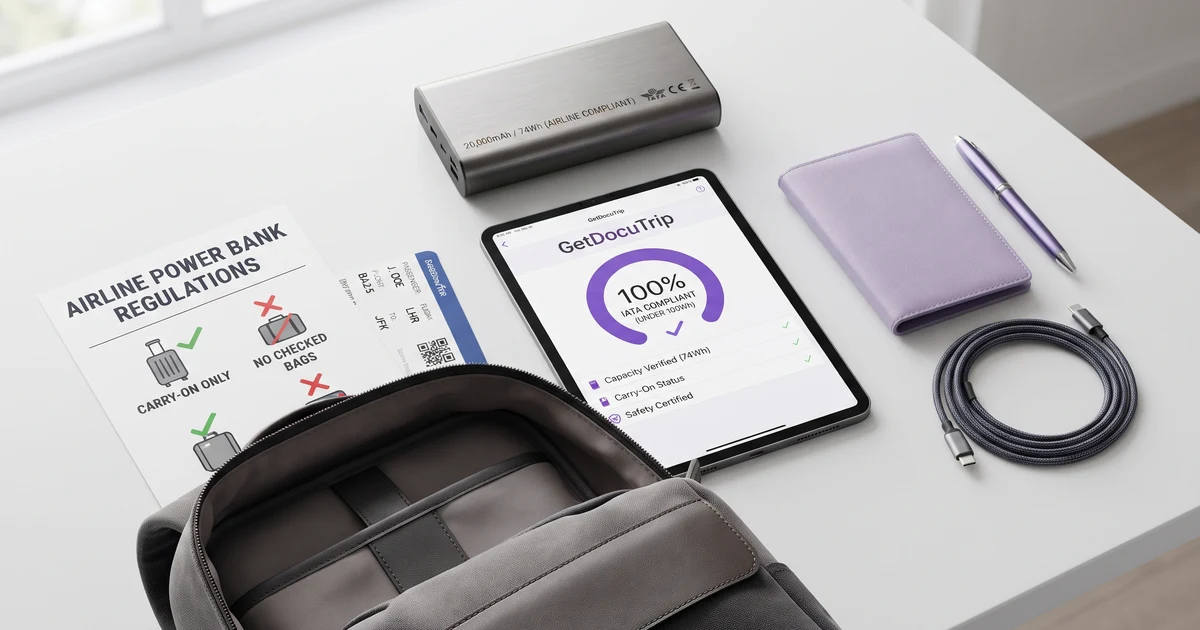
Most phone power banks are well under the limit: a 20,000 mAh bank is roughly 74 Wh. The part that now trips people up is not size but what you may do with the bank once you are in the air, because several airlines no longer allow in-flight use at all.
Key takeaways
- Power banks up to 100 Wh travel in carry-on without approval; 101-160 Wh needs airline approval (FAA, ICAO).
- Since 27 March 2026, ICAO limits passengers to two power banks each.
- Never check one. Wh = (mAh / 1,000) x V, so 20,000 mAh at 3.7 V is about 74 Wh.
- Emirates and Qantas ban in-flight use, so check your airline.
What size power bank can I take on a plane?
According to the FAA and ICAO, a power bank rated up to 100 Wh can go in your carry-on without airline approval. Banks of 101-160 Wh need approval, and anything above 160 Wh is forbidden. The watt-hour rating decides the rule, not the mAh figure printed in big letters on the box.
| Rating (Wh) | Typical mAh at 3.7 V | Carry-on | Checked bag | Airline approval |
|---|---|---|---|---|
| Up to 100 Wh | Up to about 27,000 mAh | Yes | No | Not required |
| 101-160 Wh | About 27,000-43,000 mAh | Yes, if approved | No | Required |
| Over 160 Wh | Over about 43,000 mAh | Forbidden | Forbidden | Not possible |
📋 Citation Capsule
According to the Civil Aviation Authority of Singapore (CAAS), 100 Wh is approximately 27,000 mAh and 160 Wh approximately 43,000 mAh. Power banks up to 100 Wh need no airline approval, while banks of 101-160 Wh do, and anything larger is forbidden as a spare battery in the cabin.
How do you calculate Wh from mAh?
The US Federal Aviation Administration (FAA) gives the formula: multiply volts by amp-hours. If your bank lists milliamp-hours (mAh), divide by 1,000 to get amp-hours first. That single step turns any box label into the number airlines actually care about.
Wh = (mAh / 1,000) x V
Most power banks use lithium-ion cells with a nominal voltage of 3.7 V, so the label usually works out as follows:
- 10,000 mAh: 10 Ah x 3.7 V = 37 Wh
- 20,000 mAh: 20 Ah x 3.7 V = 74 Wh
- 26,800 mAh: 26.8 Ah x 3.7 V = about 99 Wh
- 30,000 mAh: 30 Ah x 3.7 V = 111 Wh (needs airline approval)
To go the other way, divide 100 Wh by 3.7 V: about 27,027 mAh is the ceiling for the no-approval category.
📋 Citation Capsule
The FAA's formula for battery energy is watt-hours equal to volts multiplied by amp-hours. For a power bank labelled in mAh, divide by 1,000 first. At a nominal 3.7 V, a 20,000 mAh bank works out to 74 Wh, comfortably under the 100 Wh threshold for carry-on without approval.
Two practical points:
- Use the printed Wh if there is one. The FAA notes that newer lithium-ion batteries have the Wh rating marked on them. If the label prints a different voltage than 3.7 V, use that voltage in the formula.
- Check the label before you leave home. Emirates, for example, states that every power bank it accepts must have its capacity rating available. A bank with a worn-off label is a problem at the gate even if it is small. The ICAO and UK CAA texts also require the battery to meet the UN 38.3 test standard, which genuine retail banks normally list.
🔍 Unique Insight
The 26,800 mAh example shows why the label matters. At 3.7 V it lands at about 99 Wh, only one watt-hour under the line. A bank whose label prints a higher voltage could tip over 100 Wh, so the printed Wh figure beats your own mental maths.
What core rules apply almost everywhere?
According to ICAO's Technical Instructions, which regulators such as the FAA, the UK Civil Aviation Authority (CAA) and CAAS apply, spare lithium batteries and power banks must travel in the cabin. Each bank needs short-circuit protection, and the 2026 addendum caps passengers at two banks and bans recharging them on board.
- Carry-on only. Spare lithium batteries and power banks must go in the cabin. The FAA adds that if your carry-on is checked at the gate, you must pull the power bank out and keep it with you.
- Terminals protected. Each bank must be individually protected against short circuits: original retail packaging, tape over exposed terminals, or a separate plastic bag or pouch.
- Max two power banks per person. ICAO's Addendum No. 1, approved on 27 March 2026, says the two-power-bank limit is absolute and applies regardless of capacity.
- No recharging the bank on board. Plugging the power bank into a seat socket to refill it is prohibited under the ICAO addendum.
- Using it to charge a phone is discouraged. ICAO says power banks "should not" be used to recharge devices in flight. That is a recommendation at ICAO level, but individual airlines have turned it into a ban (see below).
- No damaged or recalled batteries. The FAA says damaged or recalled batteries likely to spark or overheat must not be carried in carry-on or checked bags unless the battery has been removed or made safe.
📋 Citation Capsule
ICAO's Addendum No. 1 to the 2025-2026 Technical Instructions, approved on 27 March 2026, limits each passenger to two power banks regardless of capacity. It also prohibits recharging a power bank on board and says banks "should not" be used to charge other devices in flight.
What changed with the two-per-person rule in 2026?
Before the addendum, power banks were treated like other spare batteries, with no per-person count for banks under 100 Wh. The IATA operator guidance (dated 31 March 2026) says the changes separate power banks from spare batteries, limit passengers to two power banks for personal use and prohibit recharging them in flight.
One caution on the United States: the FAA passenger page, last updated October 2026, still describes "no limits for rechargeable batteries under 100 Wh" in its own FAQ, and says many airlines have stricter limits on how many power banks you may carry. So the legal position can differ by country and airline. Plan around the strictest rule on your itinerary, which today is two.
Are 101-160 Wh banks still allowed?
They are allowed only with airline approval, and the ICAO example table shows two such banks at most. IATA's guidance for operators notes that the 100-160 Wh passenger provision will not be carried into the 68th edition of its Dangerous Goods Regulations (in force from 1 January 2027), "to manage passenger expectations". If you rely on a 30,000 mAh-plus bank, assume it may be refused in 2027 and consider a pair of smaller banks.
🔍 Unique Insight
The FAA page and the ICAO addendum don't give the same count. The FAA still points passengers to airline limits, while ICAO sets two. Packing two banks or fewer satisfies both, so that's the safe plan for any mixed itinerary.
Which airline rules go beyond the standard?
According to the airlines' own pages, several carriers are stricter than ICAO. Emirates allows one power bank under 100 Wh, Qantas allows two of up to 160 Wh but no use on board, and ANA and CAAS flights from Singapore also cap passengers at two. Always check your airline's page before you fly.
| Airline / regulator | What the official page says | Source date |
|---|---|---|
| Emirates | One power bank under 100 Wh only. No use to charge devices and no charging the bank from aircraft power. Not in overhead bins: keep it in the seat pocket or a bag under the seat in front. | In effect 1 Oct 2025 |
| Qantas (incl. Jetstar and QantasLink, per its agency notice) | Up to two power banks, each up to 160 Wh. Cannot be used or charged on board, including via seat USB ports. Keep within reach in the seat pocket or under the seat in front. | Qantas site, checked Nov 2026 |
| ANA | Up to 160 Wh, two per person, no charging the bank from in-flight outlets, and passengers are asked to refrain from using the bank to charge other devices. | Flights boarding from 24 Apr 2026 |
| Singapore (CAAS, flights departing Singapore) | Maximum two power banks per person, excess must be disposed of before the flight. Not to be charged on board, and passengers advised not to use them to charge devices in flight. | From 15 Apr 2026 |
📋 Citation Capsule
Emirates states that customers may carry one power bank under 100 Wh and may not use it to charge devices or charge it from aircraft power. Qantas allows two banks up to 160 Wh each but no use or charging on board, so the same bank can be legal on one carrier and unusable on another.
If your trip mixes airlines, for example a long-haul on one carrier and a short connection on another, follow the strictest set.
Other airlines, including Southwest and Korean Air, have announced their own power bank policies, but I did not confirm current wording on their official pages, so they are not listed here. Look them up on the airline's own site for your date of travel.
If you are still choosing flights, compare carriers' power bank policies along with price and schedule; you can search flights below. For timing and fares, see our guide to the best time to book cheap flights.
Searching for flights for your trip?
Compare real flight prices across airlines. Find options for your Schengen, US, UK, or Japan trip, then book when you are ready.
How do you pack and carry a power bank, step by step?
According to the FAA, power banks belong in carry-on baggage, and you must tell the crew immediately if one overheats, swells, smokes or burns. Qantas and Emirates add that it should sit within reach, in the seat pocket or under the seat in front. Here are the seven steps.
- Read the Wh rating. Use the printed value, or calculate it with the formula above.
- Keep it to two. Leave extra banks at home or in the hands of another passenger who will carry them under their own allowance (never combine allowances in one bag).
- Protect the terminals. Retail box, tape over the ports, or a pouch each.
- Pack it in your cabin bag within reach. Several airlines want it in the seat pocket or under the seat, not in the overhead bin. Qantas and Emirates both say this.
- Charge the bank and your phone before boarding. If your airline bans in-flight use, a full phone matters more than a full bank. Emirates itself recommends charging devices fully before flying, especially on longer flights.
- Do not pack it in checked luggage. On many airlines, including Qantas, a power bank found in checked baggage will be confiscated or disposed of.
- Tell the crew immediately if a bank overheats, swells, smokes or burns. That is the FAA's instruction.
What if you can't use the power bank in the air?
Emirates recommends charging devices fully before flying, especially on longer flights, and both Emirates and Qantas bar in-flight use. So your phone battery has to last through landing, border queues and the ride to your accommodation. Data is the other half of that: a local plan means no roaming hunt at 8% battery.
What else belongs on your packing checklist?
Power bank rules are one line in a longer pre-departure list. Visa paperwork, onward-travel proof and hotel confirmations also get checked, and it helps to keep everything in one place. Our visa document checklist covers the paperwork side, and if you travel often, a Pro account can keep your visa and travel-document research together.
Get unlimited visa checks with GetDocuTrip Pro
Unlock unlimited AI Visa Approval Predictions, advanced travel planning tools, visa deadline tracker, and personalized recommendations. From $4.99/month.
Do you need proof of onward travel?
If your checklist or your airline asks for proof of onward or return travel, a flight reservation is a documented way to show it without buying a full ticket you may not use. Read how it works in flight reservation for visa applications, and confirm with the embassy or airline first, since not every authority or airline accepts a reservation.
FAQ
What size power bank can I take on a plane?
Any power bank up to 100 Wh, roughly 27,000 mAh, can go in your carry-on. A bank rated 101-160 Wh needs airline approval, and anything above 160 Wh is forbidden. The FAA and ICAO both use the watt-hour rating, so check the label rather than the mAh figure alone.
Is a 20,000 mAh power bank allowed on a plane?
Yes. At a nominal 3.7 V, 20,000 mAh equals about 74 Wh, which is under the 100 Wh limit. Keep it in your carry-on with the terminals protected, and check whether your airline allows you to use it in flight, since Emirates and Qantas don't.
Can I put a power bank in checked luggage?
No. The FAA, ICAO and the airlines checked here all say spare lithium batteries and power banks must travel in carry-on baggage only. If your cabin bag is checked at the gate, take the power bank out first and keep it with you, as the FAA instructs.
How many power banks can I bring on a plane?
Two per person under the ICAO rule effective 27 March 2026, regardless of capacity. Some airlines are stricter: Emirates, for instance, states one power bank under 100 Wh per customer. Plan around the strictest rule on your itinerary, which today means one or two.
Can I use a power bank during the flight?
It depends on the airline. ICAO prohibits recharging the bank on board and recommends against using it to charge devices, while Emirates and Qantas do not allow in-flight use at all. Check your airline's page before you fly, and charge your phone fully before boarding.
Does a 100 Wh power bank need approval?
No, not at 100 Wh or below. Approval is needed from the airline only for banks above 100 Wh and up to 160 Wh. Even without approval, the two-bank limit and your airline's own rules, such as Emirates' one-bank limit, still apply to a 100 Wh bank.
Disclaimer
Final decisions on what you may carry or use are made by the airline, the airport security screeners and the aviation regulator of the countries on your route. GetDocuTrip is not a government agency or an airline, and this article is general information, not legal or safety advice. Rules change often, so check your airline's official page before you travel.
Sources
- FAA, PackSafe: Lithium Batteries: https://www.faa.gov/hazmat/packsafe/lithium-batteries
- FAA, Airline Passengers and Batteries (FAQ): https://www.faa.gov/hazmat/packsafe/airline-passengers-and-batteries
- ICAO, Information related to Addendum No. 1 to the 2025-2026 Technical Instructions: https://www.icao.int/sites/default/files/DangerousGoods/Guidance%20Material/1-Information-related-to-Addendum-No-1-to-the-2025-2026-Edition-of-the-Technical-Instructions.pdf
- IATA, Guidance Document for Operators: Changes Regarding Power Banks (31 March 2026): https://www-int.iata.org/contentassets/90f8038b0eea42069554b2f4530f49ea/guidance-to-operators---power-banks.pdf
- UK CAA, Changes to rules on the carriage of lithium cells/batteries and power banks: https://www.caa.co.uk/commercial-industry/airlines/dangerous-goods/changes-to-rules-on-the-carriage-of-lithium-cellsbatteries-and-power-banks
- CAAS, New Power Bank Safety Restrictions (6 April 2026): https://www.caas.gov.sg/resources/media-and-publication/newsroom/new-power-bank-safety-restrictions-to-be-implemented-on-flights-departing-singapore/
- CAAS, Pack for your flight: https://www.caas.gov.sg/resources/safety-tips-for-air-travel/pack-for-your-flight/
- Emirates, safety rules for power banks onboard (30 September 2025): https://www.emirates.com/media-centre/emirates-safety-rules-for-customer-usage-of-power-banks-onboard---now-in-full-effect
- Qantas, Spare batteries and power banks: https://www.qantas.com/en-us/baggage/dangerous-goods/spare-batteries-and-powerbanks
- Qantas, Carry-on baggage allowances: https://www.qantas.com/en-us/baggage/carry-on
- ANA, Changes to the Handling of Power Banks (14 April 2026): https://www.ana.co.jp/en/jp/special-notice/001380.html
Last verified: November 2026
Stay connected when you land with Airalo
Install an Airalo eSIM before departure and use mobile data for maps, airport transfers, hotel directions, and messages without waiting for a local SIM. New users get 15% off with code GETDOCUTRIP; existing users can get 10% off with code MENTARICH.
Affiliate disclosure: We may earn a commission from eSIM purchases at no extra cost to you.
Affiliate disclosure: Some links on this page are affiliate links. We may earn a commission at no extra cost to you.
Have a question about this article?
Our team reads every question and responds within 24 hours.
Meet the Author

Mentari Rahman
Founder & Travel Visa Expert
A tech leader who has traveled to 38 countries across 4 continents, Mentari has spent over 8 years working in the tech industry. She worked as an SEO Outreach Specialist at Canva and spent 7 years as Country Manager at Financer before founding GetDocuTrip.