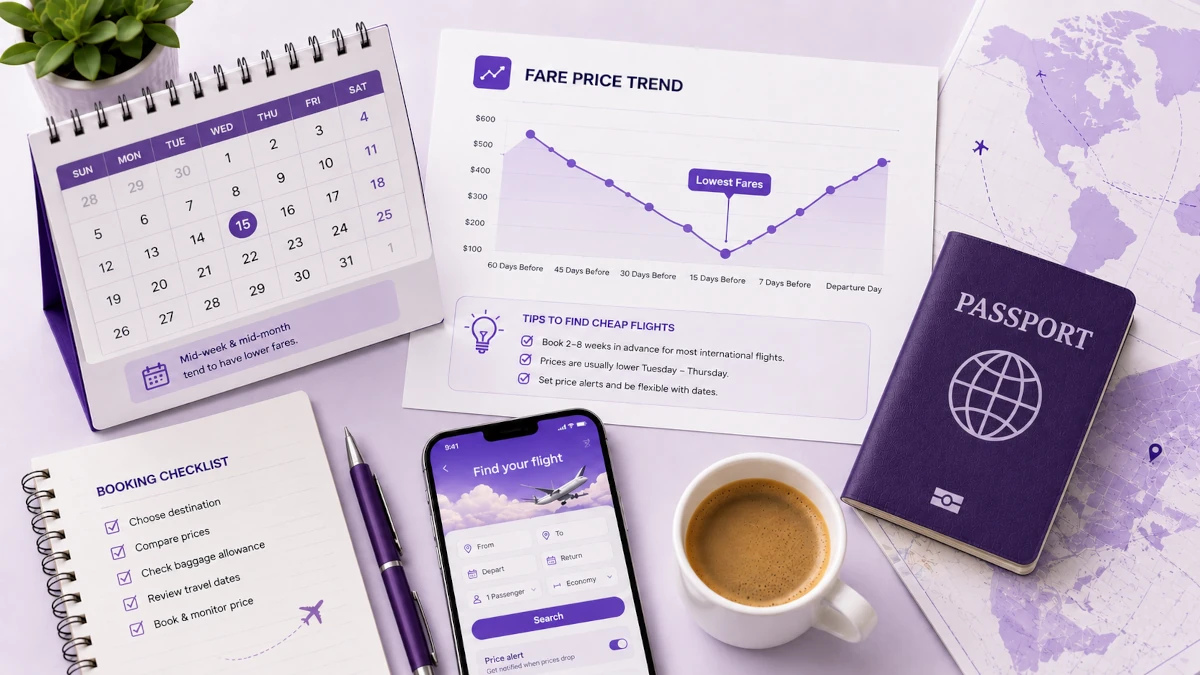
The best time to book a cheap flight is not always Tuesday at midnight, exactly eight weeks before departure, or the moment an airline opens its schedule. Airfares change because of route demand, remaining inventory, competition, seasonality, airport, cabin, and fare conditions.
That makes a universal rule impossible. A better strategy is to start monitoring when your dates are known, compare realistic alternatives, and book when the fare is acceptable for your route and travel needs.

Personal travel photo by Mentari Rahman in Singapore. It illustrates the destination-planning context of this article and does not represent a specific fare, airline endorsement, or booking result.
Key takeaways
- There is no reliable universal cheapest day to book.
- The best booking window depends on the route, travel season, flexibility, and how costly it would be to wait.
- Google Flights can track a route or specific flight and send price alerts when prices change significantly.
- The cheapest headline fare may cost more after baggage, seat, airport transfer, change, and payment fees.
- Flexible dates and nearby airports can help, but calculate the complete journey before choosing them.
- If you need proof of travel for a visa, do not buy a non-refundable ticket solely for the application unless the responsible authority requires it.
Why flight prices keep changing
Airlines use revenue management systems with multiple fare conditions. Two passengers can pay different prices for the same flight because they bought at different times, selected different fare types, or had different baggage and change needs.
Prices can move when:
- demand rises for a route,
- a holiday, festival, conference, or school break approaches,
- cheaper fare inventory sells out,
- a competing airline changes its price,
- the departure date becomes closer, or
- the airline changes its schedule or available flights.
A price change is not proof that an airline has identified you personally or that clearing cookies will reveal a hidden fare. It is usually a change in availability, demand, or the fare rules attached to the search.
So, when should you book?
Use the following as a decision framework, not a promise of a specific discount.
For fixed international travel
Start tracking as soon as you know the approximate dates. Compare several departure and return dates, then set a personal target based on the route and your budget. If the fare is reasonable and the trip is important, waiting for a perfect bottom may create more risk than savings.
For peak periods, start earlier than you would for ordinary dates. Christmas and New Year, school holidays, Eid, Chinese New Year, Golden Week, major sporting events, and large conferences can reduce availability. There is no single official number of months that guarantees the cheapest fare, but waiting until the final weeks for a fixed peak-season trip is a risky strategy.
For flexible international travel
Flexibility can be more valuable than a booking-day theory. Compare:
- a range of departure dates,
- a range of return dates,
- nearby arrival airports,
- one-stop and nonstop routes,
- different departure times, and
- different baggage options.
A flight that is $40 cheaper can become more expensive if it requires a hotel during a long connection, a costly airport transfer, or an additional checked bag.
For domestic or short regional trips
Monitor the route and compare the total fare. Short routes may have frequent departures and more competition, but prices can still rise quickly around weekends, public holidays, and events. If your dates are fixed, a reasonable fare with useful times can be better than waiting for an uncertain drop.
The Tuesday booking myth
There is no dependable universal rule that booking on Tuesday is cheaper. The price depends more on the route, dates, fare inventory, and demand than on the weekday when you click the purchase button.
The day you fly can matter because business and leisure demand changes during the week. But even that is route-specific. Compare the actual dates rather than assuming Tuesday or Wednesday will always be cheaper.
Google Flights' official price tracking help recommends tracking specific flights, routes, and dates. That is more useful than waiting for a particular weekday.
A reliable way to find a good fare
1. Define the complete trip
Write down the route, dates, cabin, number of passengers, baggage, and acceptable connection length. A cheap fare that does not fit these requirements is not a useful comparison.
2. Search flexible dates
Use a calendar or date grid to see whether leaving one day earlier or returning one day later changes the fare. If your schedule allows it, compare a full week or month rather than only one date pair.
3. Track both the route and specific flights
Google Flights allows travelers to track a route or a selected itinerary. Turn on alerts after choosing realistic dates and airports. An alert does not predict the future or guarantee that a lower price will appear. It simply helps you notice meaningful changes without searching manually every day.
4. Compare the total cost
Add the costs that apply to your trip:
- checked and cabin baggage,
- seat selection,
- meals,
- payment or service fees,
- airport transfers,
- overnight accommodation during a connection,
- change or cancellation conditions, and
- transport between alternative airports.
Compare the same assumptions for every airline. A basic fare and a flexible fare are not equivalent products.
5. Check the airline's own terms
After finding an itinerary through a comparison tool, review the airline's final fare conditions, baggage rules, transit requirements, schedule, and refund or change policy. The final price and conditions at checkout are what matter.
Peak-season booking strategy
Peak travel does not require panic buying, but it does require less patience for a perfect fare. Use this approach:
| Travel situation | Practical approach |
|---|---|
| Fixed dates during a major holiday | Start tracking early and book when the total fare fits your budget. |
| Flexible dates during a holiday period | Compare dates before and after the peak days. |
| Ordinary international trip | Monitor several routes and dates, then use a target price. |
| Short regional trip with many competitors | Compare often and check nearby departure airports. |
| Important trip with no flexibility | Prioritise schedule, connection quality, and change conditions over a speculative drop. |
| Visa application before the trip is confirmed | Check whether a reservation or itinerary is sufficient before buying a ticket. |
The right decision depends on the cost of waiting. A possible saving is not worth missing an appointment, paying for an extra hotel, or losing a non-refundable fare.
Flexible dates and nearby airports
Flexibility can uncover better options, but do not compare the ticket price alone.
For a nearby airport, calculate:
ticket + baggage + airport transfer + parking or accommodation + time cost
Also check:
- whether the airport is in the city you actually need,
- whether a transit visa is required,
- whether the arrival time has safe onward transport,
- whether separate terminals require a transfer, and
- whether the airline's change rules still work for you.
An alternative airport is useful only when the complete journey is practical and cheaper.

Personal travel photo by Mentari Rahman in Budapest. The photo is a travel illustration only and is not a hotel review or a claim about a particular flight price.
Why some booking tactics are risky
Hidden-city ticketing
Hidden-city ticketing means booking a flight with a connection at your real destination and intentionally skipping the remaining segment. It can violate airline conditions and usually cannot be used for a round trip without affecting later segments. It also creates baggage, schedule, and customer-service problems.
It is not a dependable recommendation for ordinary travelers. If a route requires a connection, book an itinerary whose final destination is the place you genuinely plan to reach.
Separate tickets
Two separate tickets can sometimes cost less, but they may be treated as separate journeys. If the first flight is delayed, the second airline may not protect the connection. You may also need to collect and recheck baggage, pass immigration, or meet a transit visa requirement.
Only use separate tickets when you have checked the airport process, allowed a generous buffer, and understand that the airlines may not be responsible for one another's delays.
Booking a non-refundable ticket before visa approval
A visa application does not normally require you to take unnecessary financial risk. Follow the responsible authority's checklist. If it asks for an itinerary or reservation, submit truthful and verifiable evidence. Do not submit an invented booking reference or an edited ticket.
Read the flight reservation for visa guide for the difference between a verifiable reservation and a fake document.
Need a verifiable flight reservation for your visa?
Get a genuine flight reservation with booking details that can be checked while the reservation is active. Check the destination checklist before submitting it.
What to do if prices rise after you book
Do not assume that every price drop can be recovered. Check the fare's change, cancellation, and credit conditions. Some airlines or jurisdictions provide limited cooling-off or refund rights, but the rules depend on the itinerary, airline, country, and fare.
For flights covered by US Department of Transportation rules, read the current airline ticket refund and cancellation guidance. For flights covered by European passenger rights, consult Your Europe air passenger rights.
Never assume a third-party booking site or an international itinerary has the same cancellation protection as a direct airline purchase. Check the seller and fare terms before payment.
A simple booking workflow
Use this workflow instead of following a fixed internet rule:
- Decide the route, dates, baggage, and connection limits.
- Search a date range and nearby airports.
- Record the total price and fare conditions for realistic options.
- Turn on route or flight tracking.
- Set a target price that fits your budget, not an invented universal average.
- Recheck the itinerary after a price alert, including transit and baggage rules.
- Book when the fare and schedule are acceptable.
- Save the confirmation, fare conditions, baggage allowance, and payment record.
If you are booking for a visa application, separate the document decision from the final-ticket decision. A visa reservation may be appropriate when the official checklist accepts it, while a confirmed ticket may be appropriate after approval or when the rules specifically require it.
Frequently Asked Questions
Is Tuesday the cheapest day to book a flight?
There is no reliable universal Tuesday effect. Prices change with route demand, inventory, dates, and fare conditions. Track the route and compare the actual total price instead.
How many weeks ahead should I book an international flight?
There is no single number that works for every route. Start monitoring once your dates are known, monitor earlier for peak periods, and book when the fare fits your budget and requirements. Waiting for a fixed eight or twelve week window can fail when demand or inventory behaves differently.
Are last-minute flights always more expensive?
No universal rule applies, but waiting is risky when your dates and destination are fixed. A lower fare may appear, but availability can also shrink or the remaining flights may have poor schedules. Book earlier when missing the trip or paying a high fare would be costly.
Should I clear cookies or use incognito mode?
Clearing cookies is not a dependable way to create a cheaper fare. Search results change mainly because of availability, demand, route, and fare conditions. Use private browsing if you prefer it for privacy, but rely on price tracking and comparison rather than this myth.
Is it cheaper to book directly with an airline?
Not always. A third-party site may display a different price or package, while booking direct may make changes and customer support simpler. Compare the final total, seller identity, baggage, change rules, and refund process before choosing.
Are flexible dates always cheaper?
No, but they give you more combinations to compare. A flexible date can be more expensive during an event or holiday, so check the complete calendar rather than assuming flexibility guarantees a saving.
Do alternative airports save money?
Sometimes. Include ground transport, baggage, parking, accommodation, transit rules, and travel time. The cheapest airfare is not necessarily the cheapest journey.
Should I buy a ticket before my visa is approved?
Follow the destination's official checklist. If an itinerary or reservation is accepted, use truthful and verifiable evidence rather than buying a non-refundable ticket solely to make an application look stronger. Confirm the current rules before submitting.
The bottom line
There is no magic weekday or universal booking window that guarantees a cheap flight. The strongest strategy is to monitor early enough for your situation, compare flexible dates and realistic airports, track prices, and calculate the total cost under the same fare conditions.
For an important trip, book when the fare is acceptable and the itinerary is practical. A small possible saving is not worth an impossible connection, an unexpected transit requirement, or a non-refundable ticket bought before your travel permission is confirmed.
Sources and official guidance
- Google Travel Help: Track flights and prices
- US Department of Transportation: Airline ticket refunds and cancellations
- Your Europe: Air passenger rights
- GetDocuTrip: Flight reservation for visa guide
Airfares and airline conditions change frequently. Confirm the final fare, baggage rules, transit requirements, cancellation terms, and seller conditions before payment.
Stay connected when you land with Airalo
Install an Airalo eSIM before departure and use mobile data for maps, airport transfers, hotel directions, and messages without waiting for a local SIM. New users get 15% off with code GETDOCUTRIP; existing users can get 10% off with code MENTARICH.
Affiliate disclosure: We may earn a commission from eSIM purchases at no extra cost to you.
Affiliate disclosure: Some links on this page are affiliate links. We may earn a commission at no extra cost to you.
Have a question about this article?
Our team reads every question and responds within 24 hours.
Meet the Author

Mentari Rahman
Founder & Travel Visa Expert
A tech leader who has traveled to 38 countries across 4 continents, Mentari has spent over 8 years working in the tech industry. She worked as an SEO Outreach Specialist at Canva and spent 7 years as Country Manager at Financer before founding GetDocuTrip.