Quick answer
Japan eVisa guide: eligibility, required documents, step-by-step application, the 15,000 yen single-entry fee from July 1, 2026, and MOFA processing times.
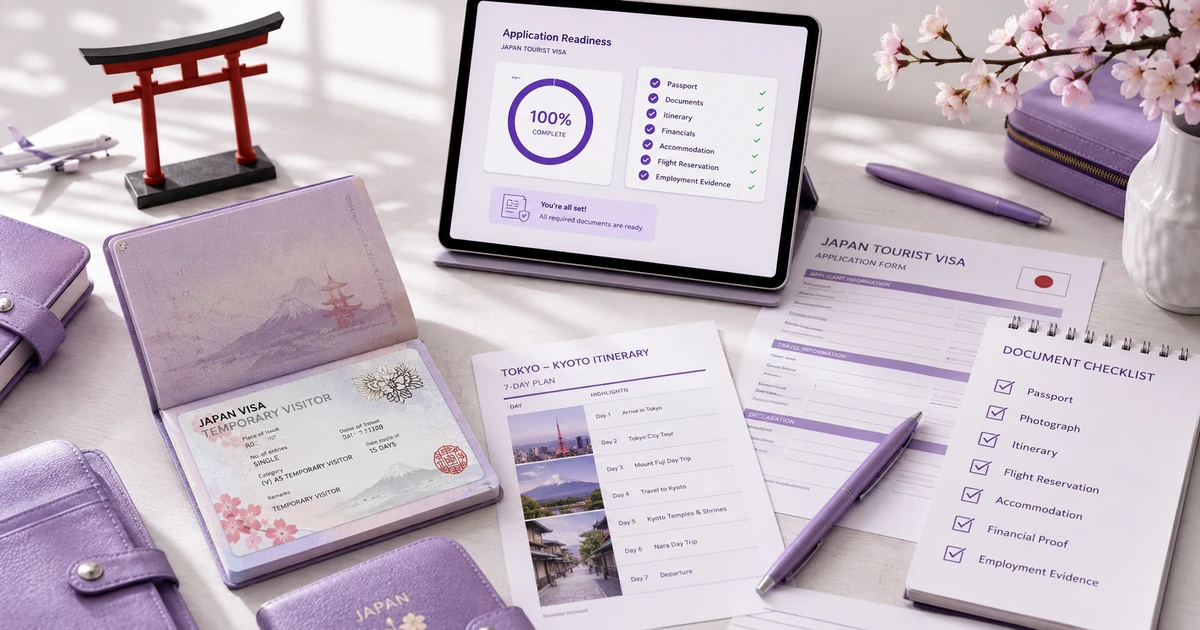
Direct answer: Japan's eVisa is an online application route for eligible foreign nationals who need a short-term visa for tourism. It covers single-entry tourist stays only. The Japanese overseas establishment with jurisdiction over your residence decides whether to grant a stay of 15, 30, or 90 days. Check eligibility before preparing documents, because the eVisa is not available for every passport, residence, or trip purpose.

Travelers who are visa-exempt for their visit do not need an eVisa. Visits to friends or relatives, business, study, work, and transit require a paper visa from the mission instead. This guide follows the current official process and ties each key rule to MOFA's eVISA FAQ.
Key takeaways
- The eVisa covers single-entry, short-term tourism only. The mission decides whether the stay is 15, 30, or 90 days.
- Only ordinary passport holders residing in eligible countries or regions can apply. Your residence matters as much as your nationality.
- Required documents depend on the Japanese mission responsible for your residence. Its instructions override any generic checklist.
- MOFA says examination normally takes five working days after a complete application is confirmed. Complex cases can take more than a month.
- The standard single-entry fee is ¥15,000 under the revised fee schedule effective July 1, 2026. Some nationalities qualify for a reduction or exemption.
Japan eVisa at a glance
| Point | Current guidance |
|---|---|
| Purpose and entry | Single-entry, short-term tourism only |
| Permitted stay | The mission decides 15, 30, or 90 days |
| Typical processing | Normally five working days after a complete application is confirmed; complex cases may take longer |
| Standard fee | ¥15,000 from July 1, 2026, with reductions or exemptions for some nationalities |
| Who should apply | Eligible ordinary passport holders who need a short-term tourist visa; visa-exempt travelers do not need an eVisa |
Check the current eligibility list, fee, and processing instructions with the Japanese mission responsible for your residence. JAPAN eVISA FAQ and MOFA eVISA guidance.
What Does a Japan eVisa Allow?
The JAPAN eVISA system issues an electronic visa for a single-entry, short-term tourist stay of up to 90 days. The mission decides the stay length from your application and itinerary. The eVisa is valid for three months after issuance and cannot be extended. It becomes invalid once it is used for landing in Japan.
There is no visa sticker in your passport. At check-in, you must display the "visa issuance notice" on a smartphone or tablet. The eVISA system requires an internet connection, so you cannot use it offline. If you have no mobile device to display the notice, MOFA suggests applying on paper instead. Multiple-entry and working visas are not available through the eVisa route.
Who Can Apply for a Japan eVisa?
MOFA says the eVisa is available to foreign nationals residing in certain countries, except those exempt from a short-term visa. Only ordinary passport holders can apply. Check the MOFA eVISA page for the current list of eligible countries and regions, since it can change.
If your nationality qualifies for visa exemption and your visit fits those conditions, you do not need an eVisa. Check the MOFA visa-exemption list before you apply.
Your residence matters, not only your nationality. Your application goes to the Japanese overseas establishment with jurisdiction over your place of residence. You must stay in your country of residence during the application process, because you may be asked to visit that mission for an interview or document check. A traveler who lives in one country but is temporarily in another cannot use the eVisa route for that application.
The eVisa is for tourism only. Use a paper visa from the mission if your purpose is visiting friends or relatives, business, study, work, or transit.
What Documents Do You Need?
There is no universal document list. The Step 1 guidance on the JAPAN eVISA website shows the documents required for your case. Then check the website of the Japanese mission with jurisdiction over your residence, because it may request specific uploads. Use both sources before you upload anything.
Core items for most applicants:
- Ordinary passport. Use the same passport for the application and for travel. The eVisa is tied to that passport.
- Facial photo. Taken within the last six months, on a plain background with no texture, and with your whole face centered.
- Email address. You need one to register an eVISA account.
- Travel itinerary. You do not need a confirmed flight ticket before applying. You can upload a flight or ship itinerary from a booking.
Family applications need extra documents. Your mission may request proof of kinship, such as a marriage or birth certificate. For broader preparation, use GetDocuTrip's visa document checklist. For Japan-specific context, read the Japan tourist visa requirements guide. Treat the official mission checklist as final.
Get unlimited visa checks with GetDocuTrip Pro
Unlock unlimited AI Visa Approval Predictions, advanced travel planning tools, visa deadline tracker, and personalized recommendations. From $9.99/month.
How to Apply for a Japan eVisa
The full eVisa process can be completed online, including payment and receipt of the eVISA. The mission may still ask you to visit in person for an interview or to submit additional documents. Follow the steps below, then use the instructions in your eVISA account.
| Step | Action | Checkpoint |
|---|---|---|
| 1 | Confirm you need an eVisa | Check visa exemption, purpose, residence, and stay length |
| 2 | Check local documents | Use JAPAN eVISA Step 1 and your responsible mission checklist |
| 3 | Register and apply | Enter passport details accurately and upload requested files |
| 4 | Submit and track | Watch for status changes and requests for more information |
| 5 | Pay when requested | Pay online only after the fee notification arrives |
| 6 | Prepare to travel | Display the visa issuance notice on an internet-connected device |
Step 1: Confirm that you need an eVisa
Check Japan's visa-exemption list first. If your nationality is exempt for the planned visit, you do not need an eVisa. If you need a visa, open the JAPAN eVISA website and check your eligibility. Confirm your purpose of visit, place of residence, and period of stay.
If you are not eligible, stop here and apply through the Japanese mission's paper process. Starting the wrong route wastes time and documents.
Step 2: Check the documents for your residence
Use the Step 1 guidance to see the documents your case requires. Open the website of the Japanese overseas establishment that serves your residence and check for any additional uploads. Collect only the items requested for your case.
Incomplete applications may be returned or cancelled. The mission examines an application only after it confirms that the application is complete.
Step 3: Register and complete the application
Create an account by registering an email address on the JAPAN eVISA website. Enter your details exactly as they appear in your passport. Upload the requested documents, then review the entire application before you submit.
If you apply for family members, the principal applicant registers everyone at the same time and all of you must travel together on the same itinerary. You cannot add family members later after the registration is completed or interrupted.
Step 4: Submit and track the status
Click Submit once everything is complete. Check your account for status changes. The statuses include Under examination, Fee payment, Issued, and Additional data materials registered. You also receive notification emails when the status changes.
The examination does not start on the day you submit. It starts when the mission confirms the application is complete. Respond quickly if the mission asks for more information or an interview.
Step 5: Pay the fee online when requested
After the mission approves the case, you receive a "Notification of visa fee" email. Pay only after this email arrives. Paying earlier is not permitted, even if the account shows a fee.
The eVisa accepts online payment by credit card only. Cash payment is not accepted at the mission. The applicant and the card holder must normally be the same person. Exceptions can apply when the applicant is a minor and a legal representative pays. If you do not have a credit card, apply in person at the mission with jurisdiction over your residence.
Card registration does not mean the eVISA is issued immediately. The mission must confirm the card registration and the payment first, so issuance can take longer.
Step 6: Receive the eVISA and prepare for travel
When the eVISA is issued, you receive a "Notification of electronic visa issuance" email. Log in to your account and display the visa issuance notice on your device. Test that it displays correctly before you reach the airport.
You can enter Japan on a different date from the one you entered, and you do not need a new application for that change. Enter Japan within three months after issuance. If you renew your passport after applying, withdraw the application and submit a new one with the new passport. An eVISA issued with the old passport details is not valid for a new passport.
Japan eVisa Fees and Processing Time
The standard single-entry visa fee is ¥15,000 under the revised fee schedule effective July 1, 2026. Some nationalities and regions qualify for a reduction or exemption under reciprocal arrangements. Check the mission serving your residence for your exact fee. No refund is available after an eVISA is issued, even if you do not travel.
MOFA says examination normally takes five working days after the mission receives and confirms a complete application. That is a typical timeframe, not a guarantee. High application volume, interviews, document verification, further information requests, or additional examination by MOFA in Tokyo can extend it. In those cases, MOFA says processing can take more than a month.
Applications can be submitted at any time, but the mission accepts them during office hours. You can apply up to three months before your travel date. MOFA does not offer expedited processing for urgent trips, so submit early.
Common Japan eVisa Mistakes to Avoid
These errors can delay or block an application:
- Using the wrong residence route. The mission depends on where you live. Use the checker for your current residence and stay in that country during processing.
- Applying for a non-tourism visit. The eVisa covers tourism only. Visits to friends or relatives, business, study, work, and transit require a paper visa.
- Treating upload as acceptance. Examination starts only after the mission confirms the application is complete.
- Using an outdated document list. Requirements vary by mission. Confirm them on the current official pages.
- Relying on a device without internet. The eVisa needs an internet connection, and you must display the notice at check-in.
- Ignoring a passport renewal. A new passport requires a new application. Check the expiry date of your passport before you apply.
- Requesting urgent processing. MOFA does not expedite decisions. Apply as early as possible.
Frequently Asked Questions
Do visa-exempt travelers need a Japan eVisa?
No. If your nationality qualifies for visa exemption and your visit fits the permitted conditions, you do not need an eVisa. Check the MOFA visa-exemption list.
Can I use a Japan eVisa to visit family or friends?
No. The eVisa is limited to tourism. For visits to relatives or friends, apply for a paper visa at the Japanese mission with jurisdiction over your residence.
How long can I stay in Japan with an eVisa?
The mission decides between 15, 30, and 90 days based on your application and itinerary. You do not choose the stay length yourself, and 90 days is not guaranteed.
How long is a Japan eVisa valid?
An eVisa is valid for three months after issuance and allows one entry. It cannot be extended. You must travel with the same passport used in the application.
How long does Japan eVisa processing take?
MOFA says examination normally takes five working days after a complete application is confirmed. Extra checks, interviews, or high demand can extend it beyond a month. The submission date does not start the examination period.
Do I need to buy a flight ticket before applying?
No. A confirmed ticket is not required before you apply. You can upload a flight or ship itinerary, which you can get by booking a ticket. If your responsible mission requests flight evidence, prepare a verifiable itinerary that matches your application and avoid non-refundable purchases while the visa is pending. Read our flight reservation guide for visa applications.
Need a verifiable flight reservation for your visa?
Get a genuine flight reservation with booking details that can be checked while the reservation is active. Check the destination checklist before submitting it.
Can I apply for family members together?
Yes, if you all travel together on the same itinerary. The principal applicant registers all family members in one session and pays one combined fee. Family members must be under the same mission's jurisdiction.
Can I change my travel dates after applying?
Yes. MOFA says you do not need a new application for a different arrival date. Enter Japan within three months after the eVISA is issued.
Can I get a refund if I do not travel?
No. Once an eVISA is issued, MOFA does not refund the fee for any reason.
Prepare Your Japan eVisa Application
Check visa exemption first. Then confirm eVisa eligibility using your actual residence, follow the documents listed by the mission that serves that residence, and pay only when the fee notice arrives. Allow time for the mission to confirm your file and make a decision.
Searching for flights for your trip?
Compare real flight prices across airlines. Find options for your Schengen, US, UK, or Japan trip, then book when you are ready.
For mobile data in Japan: Get 15% off an Airalo eSIM for your Japan trip before departure. Check device compatibility and the plan coverage before purchase.
For a side-by-side route comparison, read our Japan eVisa vs tourist visa guide. For the wider process, read the Japan tourist visa requirements guide. Use the visa document checklist for general file preparation.
Official Sources
- Ministry of Foreign Affairs of Japan, "The JAPAN eVISA system (electronic visa)": https://www.mofa.go.jp/j_info/visit/visa/visaonline.html
- JAPAN eVISA, "Frequently asked questions (About JAPAN eVISA)": https://www.evisa.mofa.go.jp/faq
- Ministry of Foreign Affairs of Japan, "Visa Fees" (revised schedule effective July 1, 2026): https://www.mofa.go.jp/j_info/visit/visa/procedure/pagewe_000001_00391.html
- Ministry of Foreign Affairs of Japan, "Exemption of Visa (Short-Term Stay)": https://www.mofa.go.jp/j_info/visit/visa/short/novisa.html
- Ministry of Foreign Affairs of Japan, "How to display a visa issuance notice": https://www.mofa.go.jp/mofaj/files/100380218.pdf
Affiliate disclosure: Some links on this page are affiliate links. We may earn a commission at no extra cost to you.
Have a question about this article?
Our team reads every question and responds within 24 hours.
Meet the Author

Mentari Rahman
Founder & Travel Visa Expert
A tech leader who has traveled to 38 countries across 4 continents, Mentari has spent over 8 years working in the tech industry. She worked as an SEO Outreach Specialist at Canva and spent 7 years as Country Manager at Financer before founding GetDocuTrip.